Five signals that a company is about to buy lead generation
Five things a company does before it buys lead generation, where to find each one for free, and what to say when you reach out.
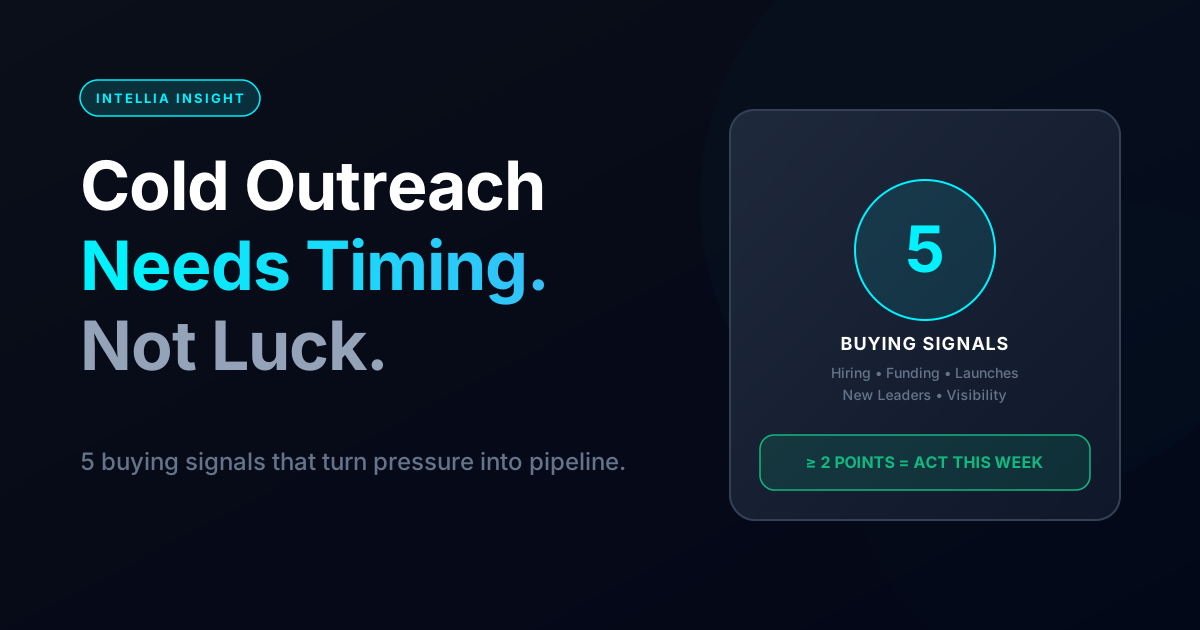
Cold outreach without timing is a coin toss. You are writing to people who have no reason to care today, and most of them do not. What changes the odds is picking companies where something has just happened that makes pipeline an urgent problem.
That is all a buying signal is. Not a guarantee, not an intent score you bought from someone. Just a visible event that says this company is under pressure to grow right now.
Here are the five worth watching, where to find each one, and what to actually say.
Are they hiring for sales or marketing?
Open roles for sales development reps, demand generation managers or growth marketers are the fastest thing to check and the most reliable. A company posting those roles has decided it needs more pipeline and has money set aside to go and get it.
Check the careers page and LinkedIn Jobs. Two things matter: which roles, and how long they have been open.
A demand generation role that has sat open for two months is more interesting than one posted last week. It means the plan exists, the budget exists, and nobody is doing the work. That is the gap an agency fills.
What to say: mention the role, then ask about the gap rather than pitching.
Saw you are hiring for demand gen. Out of interest, who is covering pipeline until they start?
Did they just raise money?
New funding comes with expectations attached. Investors want visible progress inside a year, and the first thing most leadership teams reach for is a bigger top of funnel.
Crunchbase covers announced rounds, and most companies also publish their own announcement on the blog or LinkedIn. Get there within a few weeks. Budgets for the year get set fast after a round, and once they are set you are waiting twelve months.
One caution. A funding announcement brings every vendor in the category out at once. Your message is arriving in a crowd, so it has to be about them, not about you. Skip the congratulations paragraph everyone else is writing and go straight to the question.
What to say: You raised in [month]. What does the pipeline target look like now compared to last year?
Have they launched something, or opened a new market?
A new product or a new region starts with no pipeline at all. Not a thin one, none. Existing customers are the wrong audience and the sales team has no list.
If a software company just opened in the UK, it has no UK leads and probably no UK data. That is a specific, bounded problem, which makes it an easy first project.
Look at the company blog, the press page and LinkedIn for anything in the last sixty days. Job posts in a new country count as the same signal seen from another angle.
What to say: Noticed the launch in [market]. Who are you trying to reach there first?
Is there a new marketing or sales leader?
New leaders arrive with something to prove and a short window to prove it. Many of them review existing vendors in the first quarter, and most want at least one early win they can point at.
LinkedIn announcements are the easiest place to spot this. So are changes on the team page.
Timing matters more here than anywhere else. Reach out in the first few weeks and you are part of the review. Reach out in month five and the decisions are made.
What to say: Congratulations on the new role. What are you looking at first for pipeline?
Are their competitors more visible than they are?
This one takes longer to check and lands harder when it is right.
If three companies in a category are running webinars, publishing research and showing up in search, and the fourth has posted twice this year, that fourth company usually knows. Somebody internal has already raised it. Your message just gives them the words.
Compare their LinkedIn activity, their ads and their content against two named rivals before you write. Being specific is the whole point. "Your competitors are doing more marketing" is noise. "Both of your closest competitors ran a webinar series this quarter and you have not published since March" is a conversation.
What to say: [Competitor] and [competitor] have both been running webinars this quarter. Is that something you are looking at?
How do you turn this into a list you can work?
Score it. One point per signal, checked against the companies you already care about.
| Signal | Where to look | Cost |
|---|---|---|
| Hiring | Careers page, LinkedIn Jobs | Free |
| Funding | Crunchbase, company press page | Free to start |
| Launch or new market | Company blog, LinkedIn, press page | Free |
| New leader | LinkedIn announcements, team page | Free |
| Visibility gap | Competitor content, ad libraries | Free, but slow |
Two points or more means reach out this week. One point means put it on a watch list and check again in a month. Zero points means it is a fine company that has no reason to talk to you today.
The discipline is in the second half of that. Most teams find a signal, get excited and mail everybody anyway. The scoring only helps if you let it stop you.
What signals will not tell you
They will not tell you there is budget. Hiring, funding and launches all say a company is spending, not that it is spending with you.
They will not tell you who decides. A new marketing leader may not own the lead generation budget at all.
And they do not last. A signal that is three months old has usually resolved one way or another, and reaching out then makes you look like you have been watching without acting.
Confirm budget and decision making in the first conversation. The signal got you the meeting, and that is all it was ever for.
Common questions
Are buying signals reliable?
They tell you about timing, not budget. A company can be hiring hard and still have nothing to spend with an agency, so confirm budget in the first conversation rather than assuming it.
Which tools do I need to find these signals?
None to start. Careers pages, LinkedIn, company blogs and press pages cover four of the five signals and cost nothing. Paid tools save time once you are tracking more companies than you can check by hand.
How fresh does a signal need to be?
Reach out within a few weeks. The older the signal, the more likely someone has already been chosen and the budget is gone.
Link to this article
Writing about this? Copy the address, or the ready made link.
Get new stories by email
Join the list and be first to get our best stories when the newsletter starts. One click to unsubscribe.
Comments
No comments yet. Add the first one.