What is intent data, and is it worth paying for?
What intent data actually is, where the two kinds come from, what it cannot tell you, and the conditions that decide whether it pays for itself.
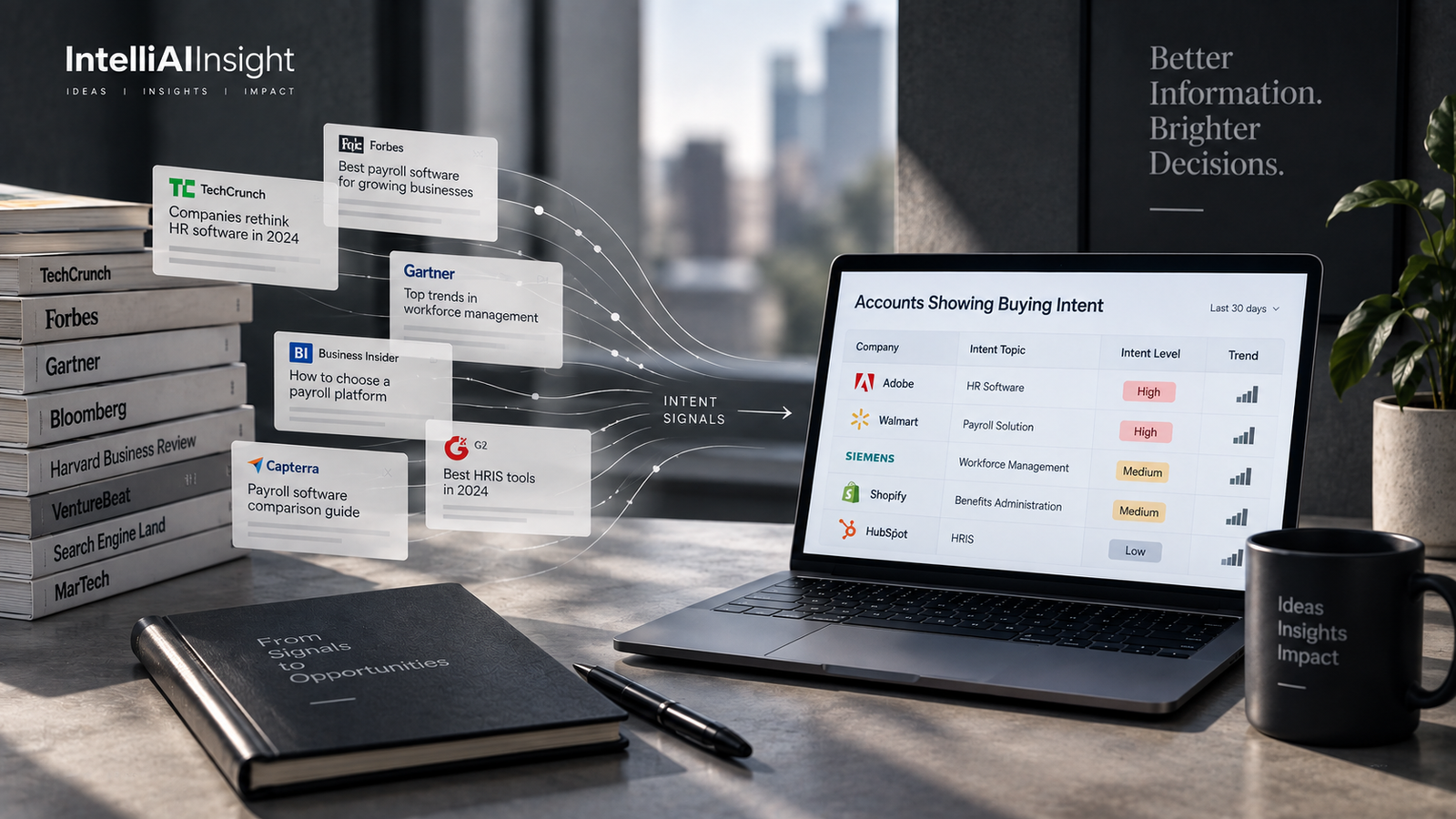
Intent data is one of those categories where the pitch is simple and the reality is not. The pitch is: we will tell you which companies are in the market right now. The reality is: we will give you a probability, built from data you cannot inspect, about a company rather than a person.
That can still be useful. It is just worth knowing what you are buying.
What is intent data, actually?
It is a signal that a company is researching a topic. It comes in two kinds, and they are very different things sold under one name.
First party intent is behaviour on your own site and content. Someone read three pricing pages. A company has visited eleven times this month. Somebody downloaded the comparison guide. You own this, it is accurate, and it costs you nothing beyond the analytics you already run.
Third party intent is bought. A vendor watches content consumption across a network of publisher sites, works out which company a visitor probably belongs to, and reports that companies in that bucket are reading about your category. You cannot see the underlying pages and you generally cannot see the people.
When someone sells you "intent data", they almost always mean the second kind.
Where does third party intent data come from?
Three main sources, usually mixed.
Publisher networks. B2B media sites share what is being read, tied to a company identified from the visitor's network address or from a form fill.
Bidstream data. Information generated when ads are auctioned, which reveals what page a request came from. This one attracts the most scrutiny on privacy grounds, and the rules on it have been changing. Check the current position for the markets you sell into rather than relying on what a vendor said last year. [VERIFY: source, current regulatory position on bidstream data in your target markets]
Co-operatives and review sites. Vendors and review platforms pool what they see about who is comparing what.
The identification step is the weak link in all three. Matching a visitor to a company is an inference, and remote work made it a worse inference than it used to be, because a person's home connection does not say where they work.
What intent data cannot tell you
It is about companies, not people. "Acme is researching payroll software" might be one person in finance with a personal curiosity, or a committee halfway through a decision. The data usually cannot tell you which.
It cannot see why. Somebody reading about your category might be a buyer, a competitor, a consultant, a student, or an employee who just wants to understand the tool they were told to use.
It lags. Research happened, then it was processed, then it appeared in your dashboard. By the time you see the spike, some of those companies have a shortlist.
It does not mean budget. Reading is free. Buying is not.
None of this makes it worthless. It makes it a prioritisation tool rather than a targeting tool, and those get sold at very different prices.
When does it pay for itself?
Intent data earns its cost when four things are true at once.
Outbound already works. You have a message that gets replies at some rate you can measure. Intent data raises that rate by putting better accounts first. It does not rescue a message nobody answers.
Sales can follow up fast. The value sits in the first week or two. If a signal lands in a queue and gets called three weeks later, you have paid for a list of companies that have already chosen.
You have more accounts than time. If your total addressable market is eighty companies, you do not need help deciding who to call. You call all eighty. Prioritisation pays off at scale.
Someone owns it. A dashboard nobody opens is the most common way this money gets wasted.
If any one of those is missing, spend the money on the message first.
What to do before you buy anything
Use your own data. Most companies have first party intent sitting unused.
- Pages viewed repeatedly by the same company, visible in your analytics
- Anyone who reached the pricing page more than once
- Content downloads, if you gate anything
- Closed lost deals from nine to eighteen months ago, which are often the warmest list you own and cost nothing
Then check the free public signals: hiring, funding, launches, leadership changes. Those are real events rather than inferences, and they are available to anyone willing to look.
If you have worked through all of that and you still need more accounts, then a paid tool is solving a problem you actually have.
Questions to ask a vendor
Ask these before the demo gets to the dashboard.
- Where does the data come from, and in what proportions?
- How is a topic defined, and can we see the keyword set?
- How many of our target accounts show up in a typical week? Ask them to run your list.
- Can we test against accounts we have already closed, to see whether the signal was there before the deal?
- What happens to accuracy for people working from home?
- What is the contract length, and what does month one look like?
That backwards test against closed deals is the most useful one. If the signal was not present before deals you actually won, it is unlikely to find the next ones.
So, is it worth it?
For a team already running disciplined outbound at reasonable volume, with sales following up inside a week, it is a reasonable way to decide what order to work a list in.
For a team whose outreach is not working yet, it is an expensive way to send the same message to a different set of companies. The order of the list is rarely the reason nobody replies.
Start with the signals you can see for free. Add paid intent when the constraint is genuinely which account to call first.
Common questions
What is the difference between first party and third party intent data?
First party is behaviour on your own properties, such as pages viewed, content downloaded and repeat visits. Third party is bought from a vendor that watches content consumption across a network of publisher sites. First party is smaller, more accurate and free. Third party is bigger and much more of a guess.
Does intent data tell you who to call?
No. Nearly all of it works at company level, not person level. It tells you a company appears to be researching something, and you still have to work out who inside it cares.
What should you ask a vendor before buying?
Ask where the data comes from, how a topic is defined, how many of your own target accounts appear in a typical week, and whether you can run a trial against accounts you already closed to see if the signal was there before the deal.
Link to this article
Writing about this? Copy the address, or the ready made link.
Get new stories by email
Join the list and be first to get our best stories when the newsletter starts. One click to unsubscribe.
Comments
No comments yet. Add the first one.