AI Software Pricing: Seats, Usage or Outcome-Based?
Compare AI pricing by the billable event, operating risk and the cost of an accepted business output.

Choose an AI software pricing model by testing the billable event against your workflow. A seat, a token, an automated action and a claimed outcome are different units. None tells you the cost of useful work until you connect it to adoption, quality, retries and human review. The buyer's task is to make that connection auditable before signing.
For global organizations, commercial predictability also depends on currency, local implementation and the responsibilities retained internally. This article offers an editorial comparison method, not vendor price guidance. The enterprise software hub provides related procurement context.
Establish what the buyer can verify
Ask a vendor to follow one representative task from initiation through processing to invoice. Identify every charge triggered by the task, including retrieval, model calls, failed runs, agent actions and external tools. Determine whether a user cancellation stops billing and whether an automatic retry creates another charged event.
Give the meter a business owner. Finance can validate invoice arithmetic, but operations must determine whether a counted event produced acceptable work. Engineering should confirm which background processes create usage. If the parties cannot reconcile these views using exported records, a disputed bill becomes difficult to resolve regardless of the advertised unit price.
Distinguish a technical limit from a spending control. A warning might notify someone after substantial usage has occurred. A hard cap might interrupt a necessary service. Require the supplier to demonstrate the configured behavior and agree the business fallback before treating either mechanism as protection.
Compare the models by where uncertainty sits
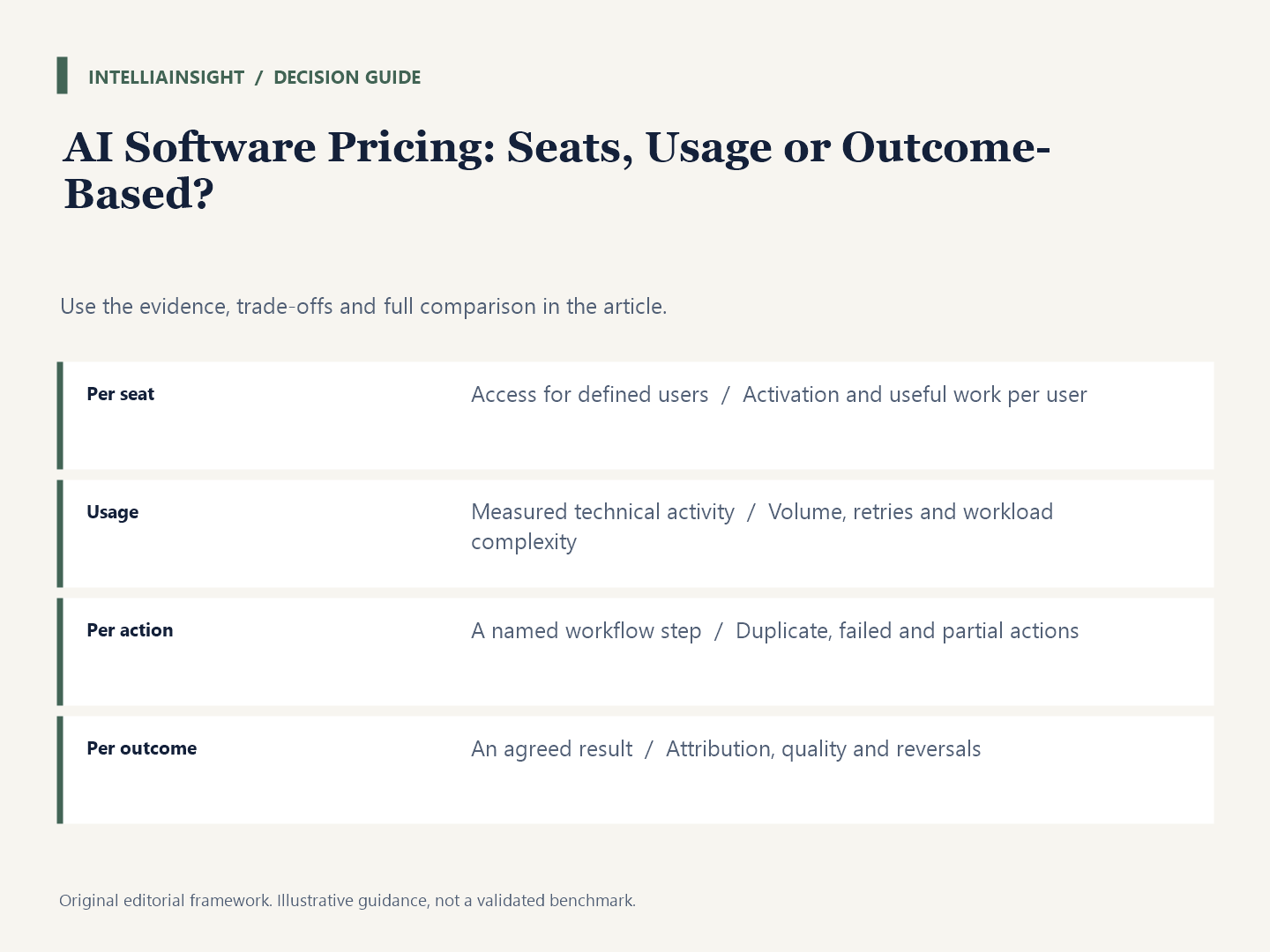
The following decision table is an editorial tool. Real offers can combine several models, so apply it to each component of the quote rather than assigning the entire contract one label.
| Model | What is purchased | Buyer uncertainty | Evidence needed |
|---|---|---|---|
| Per seat | Access for defined users | Activation and useful work per user | Role entitlements and reassignment rules |
| Usage | Measured technical activity | Volume, retries and workload complexity | Meter specification and export |
| Per action | A named workflow step | Duplicate, failed and partial actions | Event identifiers and status rules |
| Per outcome | An agreed result | Attribution, quality and reversals | Acceptance and dispute procedure |
| Hybrid commitment | Capacity plus variable charges | Unused minimums and excess usage | Tier calculation and true-up examples |
A seat commitment can be reasonable where eligible users and workflows are stable. Usage charging can preserve flexibility where demand varies, provided metering and controls work. Outcome charging becomes attractive only when both parties can define and verify a result without pushing hidden correction costs onto the buyer.
Calculate cost per accepted output
Consider an illustrative monthly document workflow. All amounts and volumes are invented planning assumptions, not supplier prices. A seat offer costs 6,000 currency units. A usage offer charges an assumed 0.40 per attempted document, with 12,000 attempts producing 10,000 accepted documents. The usage invoice is 4,800; the seat invoice remains 6,000.
Suppose both options require 2,000 in review effort. Total cost per accepted document is then 0.80 for seats and 0.68 for usage. These results depend on identical accepted outputs and equal review work. If usage requires another 2,000 of exception handling, its comparable unit cost rises to 0.88. The apparent cheaper meter no longer identifies the cheaper operating process.
Now test a volume increase, a more complex document mix and additional retries separately. Ask whether unused seats can be reassigned and whether usage commitments expire. Preserve the total cost alongside the unit cost: a lower average can still require a larger monthly budget. Finance should choose which uncertainty ranges matter to its actual forecast.
Define an outcome that survives disagreement
An outcome clause needs a completion event, quality definition, attribution rule and reversal treatment. A booked meeting is not necessarily a qualified opportunity; a generated draft is not necessarily an approved document. Choose a result the buyer can inspect without accepting the supplier's scoring system as the only evidence.
For each outcome, specify who accepts it, how long correction remains possible and what happens when downstream evidence invalidates it. Separate supplier-controlled performance from buyer dependencies such as delayed approvals or incomplete records. Otherwise an attractive shared-risk offer can turn into repeated arguments about whose process prevented success.
Review incentives as well as definitions. Paying per resolved support request could encourage premature closure unless the definition includes appropriate reopening treatment and service quality. Ask operations to explain the behavior the contract rewards before procurement negotiates its nominal rate. Do not assume a more sophisticated label creates better alignment.
Use external evidence for the right question
The 2026 State of FinOps, released 19 February, describes a global FinOps community survey in which AI cost management is the leading desired skillset. It is evidence about respondents' priorities, not a forecast of AI software prices.
The practical implication is to involve the people who can explain workload economics before committing spend. Ask them to build a sample usage-to-invoice reconciliation. Their task is not merely to estimate token volumes: it is to connect those volumes to an accepted business output and the service capacity needed when demand changes.
Salesforce's undated Siemens application account, accessed 15 November 2026, describes agents configured for lead engagement and qualification using CRM data. This vendor story illustrates workflow-specific automation; it does not disclose a transferable pricing comparison or prove financial returns.
Use that distinction in procurement. A lead qualification workflow could be charged by access, conversations or accepted handoffs. The documented application does not tell your organization which event should be billable. Your own acceptance and routing rules must settle that question.
Negotiate controls that have an operator
Assign a service owner authority to investigate unexpected usage, pause noncritical processing and approve higher limits. Document how that owner receives alerts and what happens outside working hours. For a multinational service, identify which team can act while another region is offline.
Procurement should request worked billing examples covering a failed run, a retry, a cancelled job, an exhausted commitment and a model change. State whether changes in model or feature availability can alter consumption. Ask who can activate premium features and whether an administrator can prevent users from creating additional commitments.
Retain evidence at the level needed to resolve disputes without unnecessarily storing sensitive prompts or personal data. The audit trail should connect event identifiers, accepted outputs and invoice lines. A detailed log that cannot be exported or interpreted by the buyer provides limited commercial visibility.
Make the selection conditional on the weak assumption
Present the buying committee with expected spending, downside spending and unresolved evidence for each offer. Identify the assumption most likely to reverse the result. If that assumption is review effort, run a representative workflow test. If it is demand volatility, negotiate flexibility or reduce the initial commitment.
Do not fund a commitment with unverified labour savings. Agree when the forecast will be revisited and what evidence authorizes expansion. The preferred model should remain understandable to the people who operate and pay for it after the buying team moves on.
For AI software vendors, the SaaS demand generation brief offers context for answering commercial evaluation questions. IntelliAInsight is a Lidespy LLP publication; Lidespy's content syndication services can support distribution of useful buyer education.
Sources and research dates
- State of FinOps 2026 Report — 19 February 2026; global FinOps community survey, not a representative survey of all businesses.
- Siemens takes lead response from days to minutes with Agentforce | Salesforce — Undated vendor customer story; accessed 15 November 2026.
Common questions
Is outcome-based AI pricing always better for the buyer?
No. It depends on whether the outcome is measurable, attributable and valuable after corrections or reversals. A contract can shift visible supplier risk while leaving substantial review work with the buyer. Compare the full operating cost and dispute process, then assess the incentives created by the outcome definition.
What should a software usage cap actually do?
The contract and configuration should specify whether the cap warns, queues, degrades or stops processing. Operations must know which work is affected and how to continue essential services. Test the behavior before relying on it; a notification alone does not establish that spending is constrained.
How can procurement compare a seat quote with a usage quote?
Translate both into the cost of the same accepted business outputs under common demand and quality assumptions. Include review, administration and exceptions. Then vary adoption and workload complexity. This reveals whether the apparent price advantage depends on assumptions that the buyer cannot yet substantiate.
Put this into a SaaS campaign
Connect your targeting, outreach and reporting in one plan. Our B2B SaaS demand-generation guide includes a campaign brief you can download without signing up.
Link to this article
Writing about this? Copy the address, or the ready made link.
Get new stories by email
Join the list and be first to get our best stories when the newsletter starts. One click to unsubscribe.
Comments
No comments yet. Add the first one.