SaaS Total Cost of Ownership: The Buyer’s Worksheet
Build a SaaS ownership model that includes delivery, consumption, retained work and the cost of leaving.

Compare SaaS offers against a shared operating model before comparing subscription totals. A licence quote covers only part of the decision. The buyer still needs to fund implementation, data preparation, integrations, administration, consumption and a usable exit. A cheaper contract can demand more internal work; a higher subscription can remove work only if the relevant process actually changes.
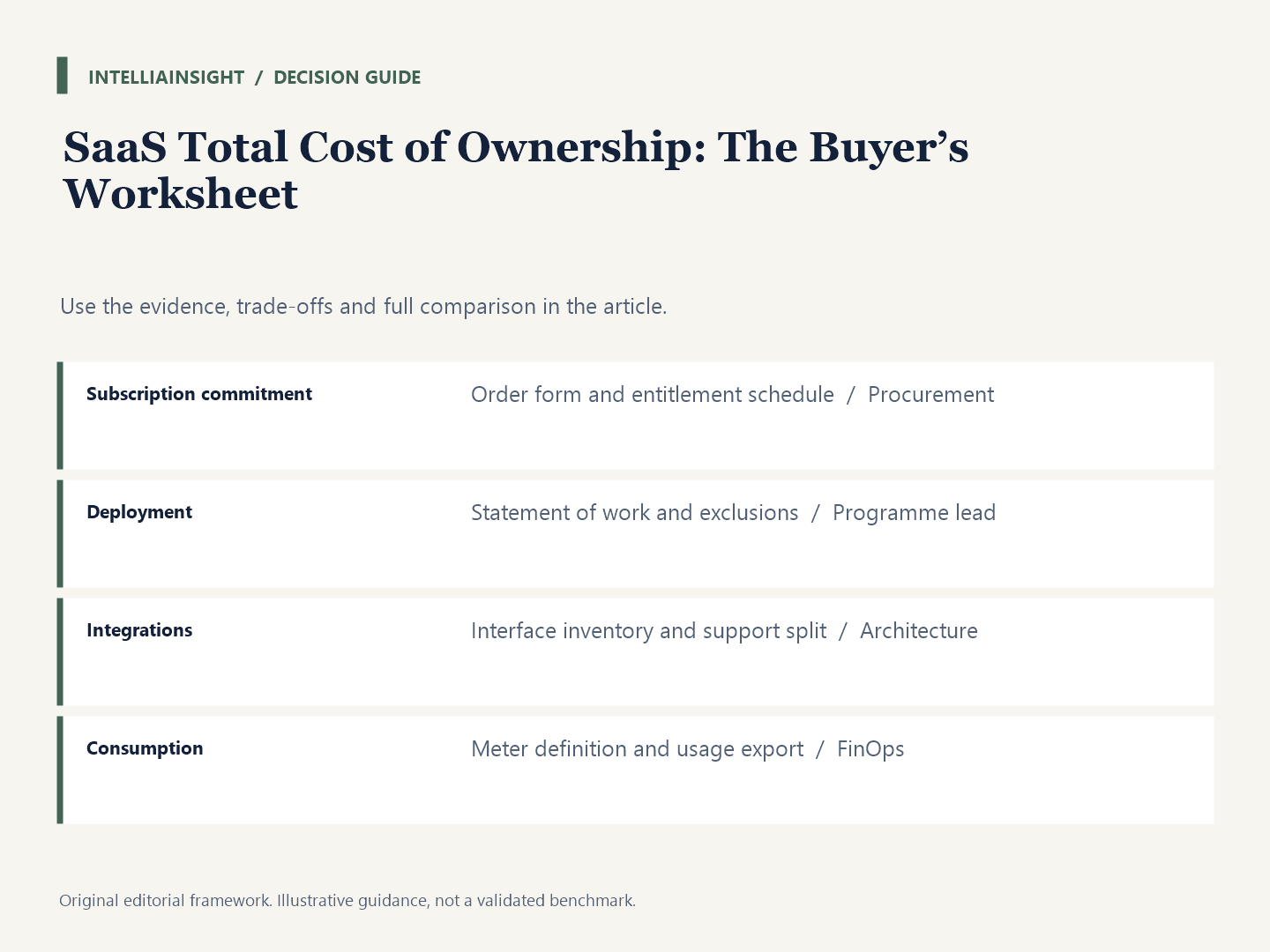
This worksheet is an editorial method for CIOs, procurement teams and finance partners. Its purpose is to expose assumptions before commitment, then give the operating owner a model that can be reconciled against actual spending. Related enterprise software analysis can support the broader buying discussion.
Define an equivalent service before costing it
Write a service boundary that both bidders must price: named user groups, workflows, countries, data volumes, required integrations, availability needs and support responsibilities. Distinguish launch scope from later expansion. Without that boundary, a full implementation proposal and a licence-only quote can look deceptively comparable.
Document the existing operating baseline separately. Include supplier spending and the internal activities that the new service might replace. An administrator whose role remains necessary is a retained cost, even if some tasks become quicker. Staff capacity released for other work is a possible operational benefit; it becomes cash savings only when a budget line actually changes.
Finance should own currency, tax treatment and discounting conventions. Business leaders should own volume assumptions. Procurement should preserve the quoted commercial conditions, including minimum commitments, renewal mechanics and responsibilities excluded from implementation. Give every important input an owner, evidence date and uncertainty range.
Build the ownership ledger
Use one row per cost driver rather than a single implementation allowance. Separate cash payments from valued internal effort so decision makers can see both funding needs and organizational capacity. Avoid counting the same employee time in a project allocation and again in a supplier delivery estimate.
| Cost driver | Evidence to request | Owner | Sensitivity to test |
|---|---|---|---|
| Subscription commitment | Order form and entitlement schedule | Procurement | Active roles and minimum seats |
| Deployment | Statement of work and exclusions | Programme lead | Data readiness and local variants |
| Integrations | Interface inventory and support split | Architecture | Change frequency and failures |
| Consumption | Meter definition and usage export | FinOps | Retries, peaks and background jobs |
| Internal operations | Task inventory and effort estimate | Service owner | Administration and exception work |
| Exit | Export terms and replacement plan | Data owner | Archive, overlap and reconstruction |
For each row identify whether the amount is committed, estimated or contingent. A contingent amount should not disappear because it is uncertain: show the event that would trigger it and the evidence needed to narrow its range. Keep transition spending visible in the year when cash is required.
Use scenarios instead of a single confident total
An illustrative three-year comparison uses generic currency units, with no claim about market prices. Offer A has annual subscription and consumption of 120,000, initial deployment of 90,000, annual retained operations of 40,000 and an exit allowance of 30,000. Its undiscounted ownership cost is 600,000: three times 160,000, plus 120,000 in deployment and exit.
Offer B assumes annual subscription and consumption of 150,000, deployment of 45,000, retained operations of 25,000 annually and exit of 20,000. Its equivalent total is 590,000. The apparent annual subscription disadvantage reverses in this assumed operating model. These numbers establish no recommendation about a real vendor.
Now change the assumption with the greatest uncertainty. If A's consumption rises by 20,000 annually while B's stays fixed, A becomes 660,000. If B instead requires an additional integration project costing 50,000, B becomes 640,000. Record which proposal wins under each plausible scenario and which missing evidence could change the choice. Compare equivalent functionality throughout; removing a required workflow is a scope change, not an efficiency gain.
Connect spending to useful units
The State of FinOps 2026 reports that 90% of its global FinOps community respondents manage SaaS or plan to within a year. Released on 19 February 2026, that finding describes this community, not all companies.
Use the implication as a planning question: can your finance and technology teams reconcile SaaS cost to a useful service unit? For a support platform, that might be a satisfactorily resolved case within the agreed service boundary. For a workflow product, it might be a completed and accepted transaction. Include failed attempts and rework in the cost numerator even when they create no accepted output.
A unit measure supports operating comparisons, but it does not substitute for the total funding requirement. Volume can lower average cost while raising the invoice. Show both figures, and explain changes caused by customer mix, transaction complexity or expanded scope before interpreting them as efficiency.
Treat integration as an operating responsibility
Microsoft's Schneider Electric account, dated 15 October 2024, describes Copilot for Sales integrated with Salesforce and employees using it through Teams and Outlook. This is a vendor-published application, not independent evidence of ownership cost.
Its relevance to the worksheet is architectural. A service can span products and suppliers while appearing to users as one workflow. Ask who repairs a broken field mapping, responds when an authorization expires, tests an upstream change and trains employees when screens change. Include that responsibility even if a connector is supplied without a separate licence charge.
Request a support handoff demonstration using an integration failure. The buyer should be able to identify the accountable party, available logs and escalation path. A proposal that leaves these unresolved needs a larger uncertainty allowance or further discovery before approval.
Price the ability to leave
An export clause does not establish that a replacement can use the output. Ask for representative records, attachments, relationship identifiers, permission metadata and historical changes. Have the data owner attempt reconstruction in a neutral environment. Record what is missing and whether a paid service is needed.
Include the period when both systems must operate, specialist effort to reconcile records and any archive required after termination. Confirm whether administrative access, export APIs and support remain available during that period. Retention and deletion requirements depend on jurisdiction and contractual context; qualified internal advisers should establish the applicable obligations.
Exit spending belongs in the model even when the intended decision is a long partnership. It describes the cost of preserving choice. An option with a modestly higher expected cost may still be preferable if the alternative exposes a critical process to an unmanageable replacement effort.
Turn the buying model into a review instrument
Before signature, finance should challenge the largest uncertain inputs while the business owner confirms service equivalence. Approve the chosen scenario and explicitly document downside funding, unresolved conditions and who can authorize expansion. Do not bury an optimistic adoption assumption in a spreadsheet formula.
After launch, reconcile invoices to entitlements and usage, then compare implementation effort with the agreed assumptions. Change the forecast when evidence changes. Keep a separate benefits register with named owners so unverified productivity claims never silently offset committed payments.
For software vendors explaining these trade-offs to buyers, the SaaS demand generation brief can help turn cost questions into useful evaluation content. IntelliAInsight is a Lidespy LLP publication; vendors seeking support distributing that content can explore Lidespy's content syndication services.
Sources and research dates
- State of FinOps 2026 Report — 19 February 2026; global FinOps community survey, not a representative survey of all businesses.
- Schneider Electric charges into the future with Microsoft Copilot for Sales | Microsoft Customer Stories — 15 October 2024; vendor customer story.
Common questions
Should internal employee time be included in SaaS TCO?
Yes, when it is necessary to implement or operate the service. Show valued staff effort separately from cash expenditure and distinguish retained roles from genuinely removable spending. This lets finance assess affordability while operations checks whether the people required to deliver the plan are actually available.
How should buyers compare uncertain consumption charges?
Agree a meter definition, obtain usable consumption records and build scenarios using your expected workload mix. Include retries, testing and background processing where billable. Ask procurement to document caps and notifications, then identify which volume assumption would make the preferred proposal financially unacceptable.
Does a lower TCO automatically justify a purchase?
No. Ownership cost is one decision input alongside workflow suitability, delivery risk and business value. A proposal with an attractive total should still fail if it cannot meet a necessary service requirement. Keep those acceptance conditions visible alongside the cost model so they cannot be traded away accidentally.
Put this into a SaaS campaign
Connect your targeting, outreach and reporting in one plan. Our B2B SaaS demand-generation guide includes a campaign brief you can download without signing up.
Link to this article
Writing about this? Copy the address, or the ready made link.
Get new stories by email
Join the list and be first to get our best stories when the newsletter starts. One click to unsubscribe.
Comments
No comments yet. Add the first one.