AI Recruiting Software: Evaluate Evidence and Oversight
Evaluate AI recruiting tools through job-relevant evidence, accessible candidate journeys and review authority that works in practice.

Buy AI recruiting software only after defining which hiring decisions it may influence, what evidence supports that use and who can reverse a mistake. A useful evaluation starts with one role and a documented assessment rubric. A broad claim about matching quality cannot establish whether a tool is suitable for your candidates, languages or selection process.
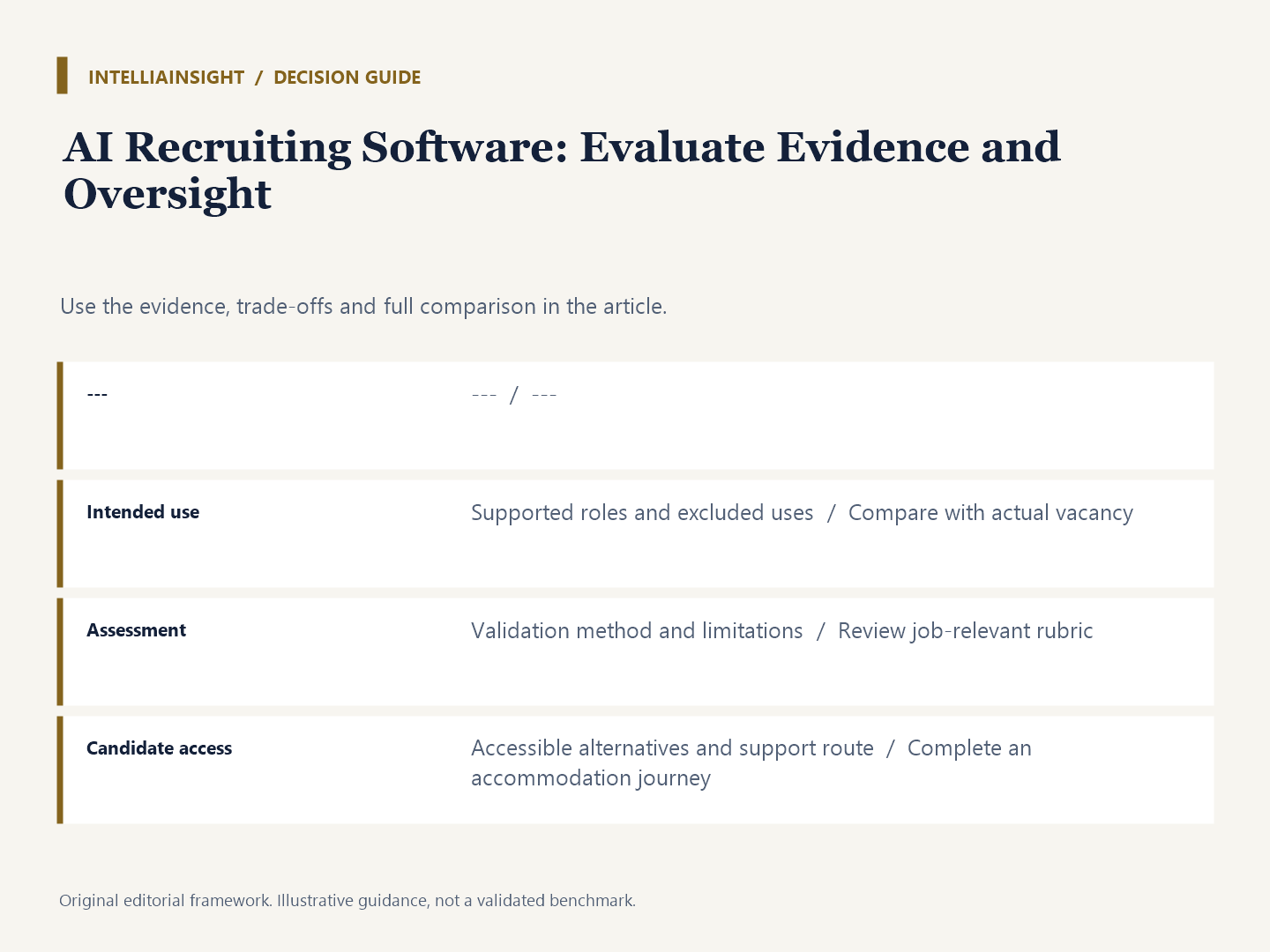
Separate assistance from selection
A system that schedules interviews creates different consequences from one that ranks applicants or recommends rejection. Map each proposed action, the data it consumes and the person accountable for the result. Include indirect influence: a recruiter may technically approve every decision while seeing only the candidates the software places first.
Ask the vendor to demonstrate an ordinary application, an incomplete application and an accommodation request. Observe what disappears from the recruiter’s view. Keep a route for a candidate to submit equivalent evidence through another format. The objective is a workable assessment process; requiring every applicant to fit a convenient input template can undermine that objective before any model runs.
Use an evidence gate before a score
Our editorial procurement method separates conditions that must be satisfied from features that can be compared. Accessibility, accountable review and an intelligible record of decisions belong in the first group. Better scheduling or a more attractive dashboard should not compensate for a missing way to contest an erroneous application record.
| Decision area | Evidence to request | Local check | Accountable owner |
|---|---|---|---|
| Intended use | Supported roles and excluded uses | Compare with actual vacancy | Talent acquisition |
| Assessment | Validation method and limitations | Review job-relevant rubric | Assessment specialist |
| Candidate access | Accessible alternatives and support route | Complete an accommodation journey | Candidate experience |
| Review authority | Override and escalation records | Reverse an incorrect recommendation | Recruiting manager |
| Data handling | Retention, access and model-use terms | Trace a deletion request | Privacy and IT |
The NIST AI Risk Management Framework, first released in 2023 as voluntary guidance, provides a useful governance reference. It does not certify a recruiting product or establish that a particular hiring decision is lawful.
Test the decision pathway
Build a review set around the work the job actually requires. Have qualified assessors evaluate evidence without seeing the software’s ranking, document disagreements and reconcile ambiguous rubric items. Otherwise a model can appear inconsistent simply because the organization has never agreed what a good application demonstrates.
Include cases that expose practical limitations: career breaks, translated qualifications, transferable experience, unusual document structures and incomplete employment histories. These are test dimensions, not assumptions that any candidate group lacks competence. Where demographic analysis is appropriate, specialists should determine lawful collection, suitable methods and uncertainty. A small evaluation with no detected disparity is not proof of fairness; aggregate agreement can conceal consequential errors for a smaller group.
Inspect false exclusions separately from extra review work. A qualified applicant pushed below the review cutoff may never become visible in a conventional interview conversion metric. Sample beyond the recommended shortlist, record why reviewers disagree and determine whether the issue lies in parsing, inference, the rubric or recruiter practice.
Make human review operational
An override button is insufficient when a recruiter has neither time nor underlying evidence. Require the interface to show the relevant application material, the version of the recommendation and the reason for intervention. Ask the vendor to export that record, because the organization may need to investigate after a configuration or model change.
Set a review capacity budget before enabling recommendations. If a hiring campaign creates more disputed cases than the team can examine, narrow the software’s role or add capacity rather than silently allowing the queue to age. A recruiting leader should own the fallback process, while an assessment specialist owns rubric quality. Neither responsibility should disappear into a generic vendor support ticket.
Work through a realistic comparison
Consider an illustrative employer comparing two tools for a customer support vacancy. The planning assumption is that both tools see the same approved job rubric and a set of consented or appropriately constructed evaluation records. One extracts application facts; the other adds a suitability ranking. These are hypothetical options, not descriptions of named products.
The fact-extraction tool misses a qualification embedded in a scanned document. The ranking tool reads it correctly but discounts equivalent experience because of a poorly chosen requirement. The first defect needs an input-handling remedy; the second requires scrutiny of the selection logic and job criteria. Combining both under one accuracy percentage would obscure who must fix what.
The buyer records review minutes, disputed decisions, candidate support requests and reasons for exceptions. It also records unresolved uncertainty. Choose an acceptable workload and evidence standard before evaluating results; the appropriate threshold depends on the role and decision consequences. Do not borrow an arbitrary percentage from a vendor slide or this example.
Preserve early-career routes
The WEF and PwC entry-level work paper, published in June 2026, treats access and development pathways as related design questions. It does not validate an applicant-ranking product. Its useful implication for procurement is to examine whether new screening criteria remove opportunities to demonstrate potential.
Ask hiring managers which capabilities must exist on arrival and which can be learned with supervision. A criterion added for screening convenience can inadvertently redefine an entry role as an experienced hire. Examine the complete hiring journey, including assessments and interviews, before attributing changes in candidate progression to the software. Preserve training and supervised work opportunities when redesigning the role.
Contract for continuing scrutiny
Specify notice of material changes, access to evaluation records, relevant subcontractor disclosures and a way to suspend the affected feature. Agree how historical decisions can be investigated when the vendor updates its model. Document what happens to candidate data on exit, including backups and data supplied to subprocessors; a deletion button does not explain the whole lifecycle.
Ask local employment and privacy specialists to assess the actual jurisdictions and proposed use. Global procurement can standardize evidence requests while allowing local restrictions. Before expansion, repeat the review for a materially different role, language or applicant population. A successful trial in one setting supports that setting; it does not authorize unrestricted deployment across the company.
The final recommendation should name the permitted use, unresolved limitations, retained review workload and rollback owner. That document is more useful to an approving CHRO than a composite score with unexplained weights. Keep an explicit option to buy administrative assistance while postponing selection automation.
Further reading and vendor resources
Explore related decisions in HR technology and the future of work. For HR technology vendors turning buyer evidence into a campaign, the SaaS demand generation brief helps connect an asset to a buying decision.
IntelliAInsight is a Lidespy LLP publication. HR technology vendors seeking relevant buying audiences can explore Lidespy’s audience intelligence services.
Sources and research dates
- AI Risk Management Framework | NIST — AI RMF 1.0 released 26 January 2023; landing page accessed 15 November 2026.
- World Economic Forum — 22 June 2026.
Common questions
Should we require the vendor to reveal its source code?
Source code alone will not establish suitability. Start with intended use, evaluation methods, relevant limitations, data handling and decision records. Where a material risk remains unexplained, seek specialist review or contractual access appropriate to the issue. Decline the affected use if the evidence is insufficient.
Can a shadow evaluation establish that the system is fair?
A shadow evaluation can reveal discrepancies and workflow problems without changing live decisions. Its strength depends on representative cases, sound assessment criteria and appropriate analysis. It cannot establish universal fairness, especially with small groups or a different future applicant population. Keep ongoing review and accessible challenge routes.
What should trigger a pause?
Pause the affected function when decision records cannot be reconstructed, candidate access fails, a material change lacks evaluation or reviewers cannot handle consequential disagreements. Define additional role-specific triggers with qualified stakeholders before launch. A pause should activate a documented manual process and an owner responsible for resolution.
Link to this article
Writing about this? Copy the address, or the ready made link.
Get new stories by email
Join the list and be first to get our best stories when the newsletter starts. One click to unsubscribe.
Comments
No comments yet. Add the first one.