Contractor or employee: how to tell the difference
How US worker classification is actually decided, which agencies apply which test, the questions that matter most, and what to do if you think you got it wrong.
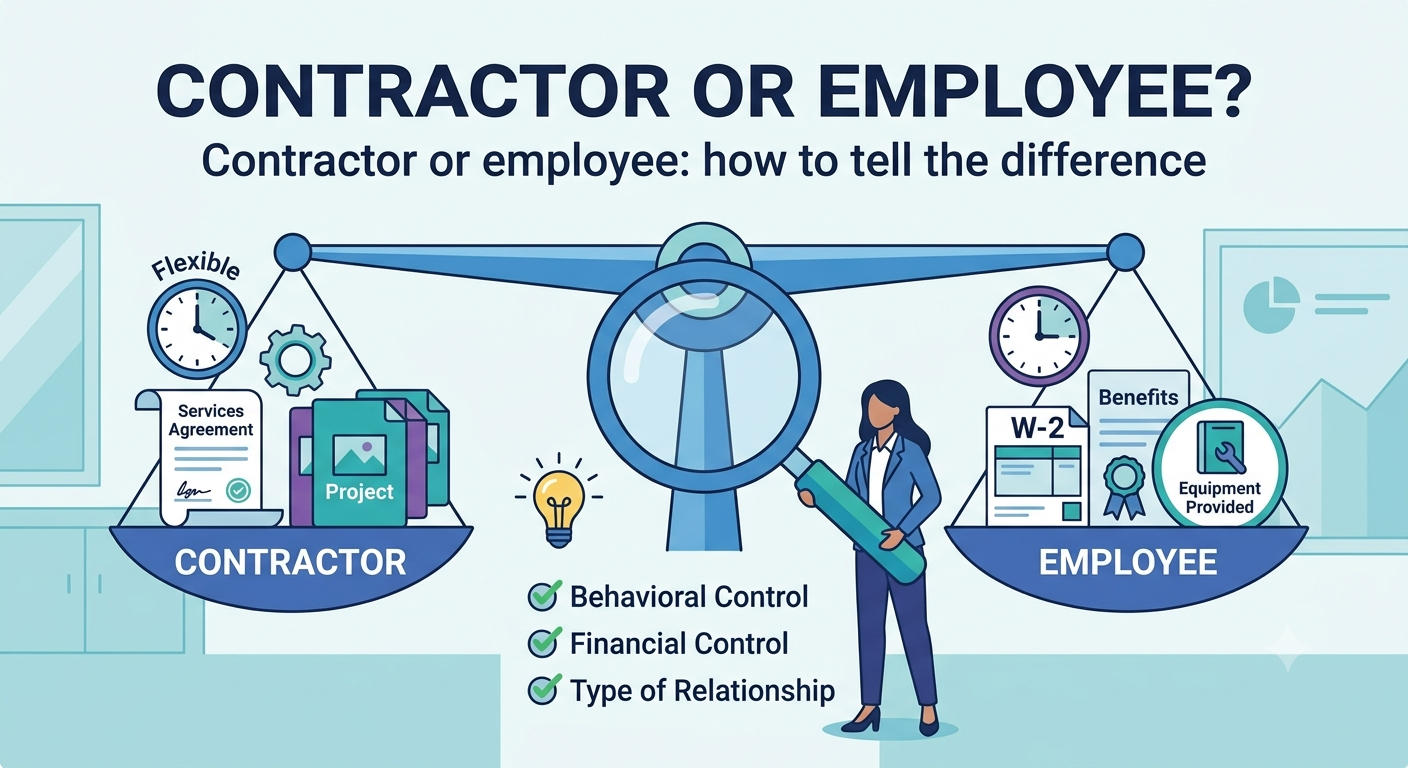
This is the question small businesses get wrong most often, and usually in good faith. Someone works a few hours a week, invoices you, and calls themselves a freelancer. It feels obvious.
The problem is that in the United States nobody involved in the relationship gets to make this decision. It is decided by how the work actually happens, judged after the fact, by whichever agency is asking.
Why it matters
Classification decides who pays what.
For an employee, you withhold income tax, pay your half of Social Security and Medicare, pay federal and state unemployment tax, and follow wage and hour law including overtime. You may also owe benefits under your own policies or under state law.
For a contractor, you pay an invoice and issue a 1099 at year end.
The gap between those two is large enough that getting it wrong creates real liability: back taxes, penalties, interest, and potentially unpaid overtime. The federal and state penalty structures differ, and they are harsher where the misclassification is judged intentional. [VERIFY: source, IRS and Department of Labor guidance on misclassification consequences]
Who decides, and by which test
There is no single national test. At least three groups of rules can apply to the same worker.
The IRS looks at the relationship across behavioural control, financial control and the nature of the relationship itself. It publishes guidance on how these are weighed, and no single factor decides it. [VERIFY: source, IRS guidance on independent contractor versus employee]
The Department of Labor applies its own analysis for wage and hour purposes under the Fair Labor Standards Act. The federal approach here has been revised more than once in recent years, so check the current rule rather than an older summary. [VERIFY: source, current Department of Labor rule on employee or independent contractor classification under the FLSA]
Your state. Several states use a stricter test than the federal one, and some have adopted a version of what is commonly called the ABC test, which presumes employment unless specific conditions are met. State rules also vary by purpose, so a state may use one test for unemployment insurance and another for wage claims. [VERIFY: source, your state's worker classification test for each relevant purpose]
The practical consequence: satisfy the strictest test that applies to you, not the most convenient one.
The questions that actually decide it
Strip the tests down and most of them circle the same three areas.
Who controls how the work gets done?
Do you set the hours, or do they? Do you say how the work is performed, or only what the outcome should be? Do they need permission to take on other clients? Do you train them in your methods? Do they use your equipment and your systems?
The more you direct the method rather than the result, the more this looks like employment. A contractor is hired for an outcome. An employee is directed in how to reach it.
How financially independent are they?
Do they have other clients? Have they invested in their own tools? Can they make a profit or a loss on the engagement, or are they simply paid for time? Do they market themselves, have a business identity, carry their own insurance? Do they set their own rate?
Someone who works only for you, on your equipment, at a rate you set, is not carrying any business risk, and that points strongly to employment.
What does the relationship look like over time?
Is there an end date, or has it just continued? Is the work central to what your business sells, or is it a support function? Do they receive anything that looks like a benefit? Have they been there long enough to be indistinguishable from staff?
A designer engaged for a specific project looks different from a designer who has been doing all your design work for three years on a rolling basis.
Signs that a contractor has quietly become an employee
These patterns come up again and again.
- They started on a project and never left, and nobody remembers when the project ended
- You tell them which days and hours to work
- They are on your internal chat, in team meetings, with a company email address
- They do the same work as an employee on your payroll
- You are their only client, or nearly
- They ask you for time off rather than telling you they are unavailable
- They use your laptop and your software licences
- There has been no written scope of work for a year
None of these on its own decides anything. Several together is the shape of an employment relationship wearing a contractor label.
What to do if you think you got it wrong
Do not quietly change the arrangement and hope. The history is what gets examined.
Talk to an employment lawyer or an accountant before you act. This is the one area in this article where professional advice pays for itself immediately, because the right move depends on how long it has run, which state you are in, and how much money is involved.
Understand what relief exists. There are IRS programmes for voluntarily reclassifying workers, with their own eligibility conditions, and acting voluntarily is generally treated differently from being found out. [VERIFY: source, IRS Voluntary Classification Settlement Program eligibility and terms]
Fix the process, not just the person. If one contractor drifted into employment, others probably did too.
How to keep genuine contractor relationships clean
Write a scope of work with a defined deliverable and an end date, and renew it deliberately rather than letting it roll.
Pay per deliverable or per project where you can, rather than for hours that look like a working week.
Let them decide how and when, within the deadline.
Let them use their own tools. Where they must use your system for access reasons, document why.
Keep them out of anything that signals staff membership: performance reviews, team objectives, internal org charts.
Keep the evidence. Their invoices, their business details, the signed scope, any sign they work for others.
Review every contractor relationship once a year against the questions above. Drift happens slowly and is only obvious in hindsight.
The short version
If you are directing how the work happens, if they depend on you financially, and if the arrangement has no end in sight, it is probably employment, whatever the paperwork says.
This article is general information, not legal or tax advice. Classification is fact specific and the rules differ by state and by agency. Use irs.gov, dol.gov and your state agency as the source of truth, and take professional advice before reclassifying anyone.
Common questions
If they signed a contractor agreement, are they a contractor?
Not necessarily. A written agreement is one piece of evidence, and agencies look past it to how the relationship actually works. A contract saying someone is a contractor does not protect you if the day to day facts say otherwise.
Can the same person be a contractor for one agency and an employee for another?
Yes, and it happens. The IRS, the Department of Labor and individual states apply different tests, and some states use stricter ones than the federal government. Check each test that applies to you.
Can I ask the IRS to decide?
There is an IRS form for requesting a determination of a worker's status. It is slow, so it is a planning tool rather than an answer to a question you need this week. [VERIFY, source, IRS Form SS-8 and its current processing guidance]
Link to this article
Writing about this? Copy the address, or the ready made link.
Get new stories by email
Join the list and be first to get our best stories when the newsletter starts. One click to unsubscribe.
Comments
No comments yet. Add the first one.