Payroll tax deadlines a small business should track
The payroll deadlines a US small business has to meet, who sets each one, why your deposit schedule is personal to you, and a simple way to stop missing them.
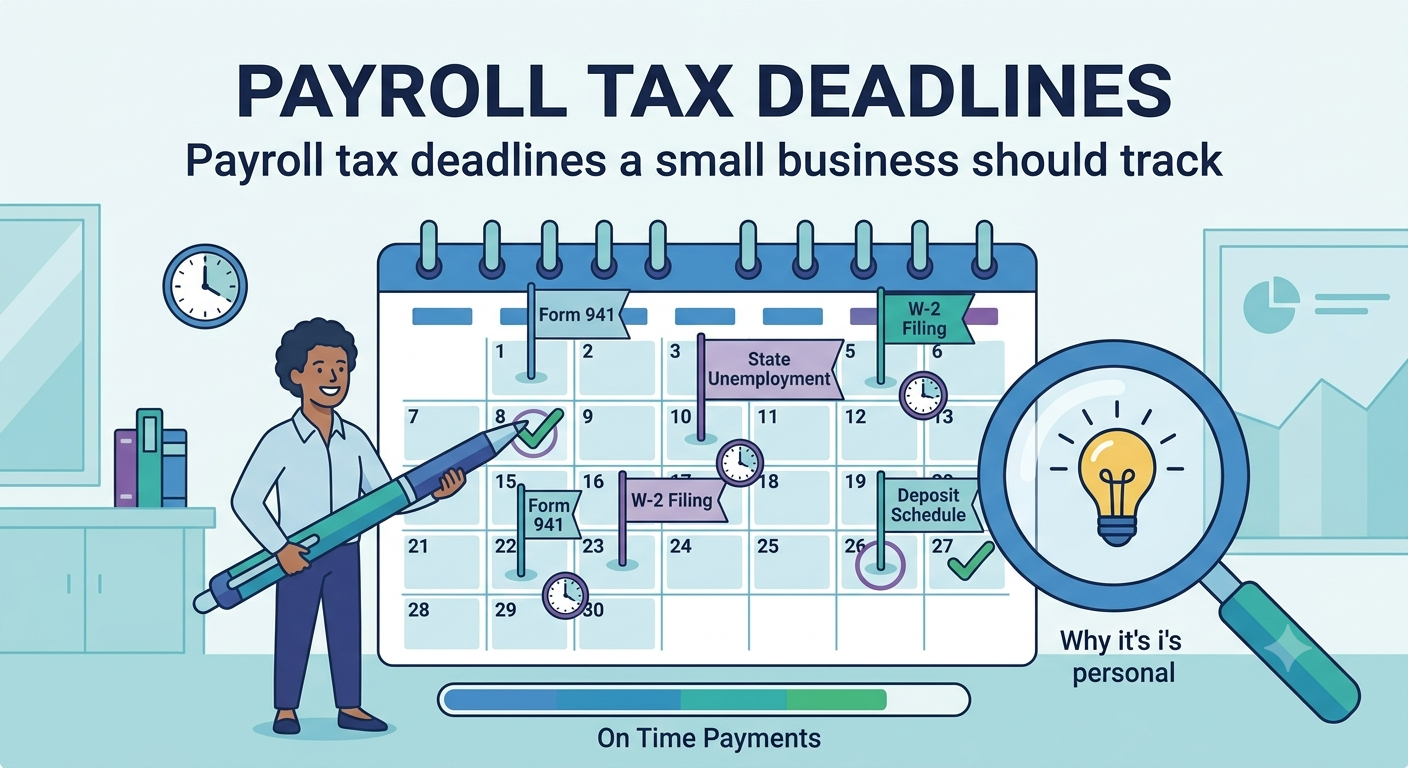
Payroll deadlines are not hard to meet. They are hard to remember, because they come from several agencies, they do not share a calendar, and one of the most important ones is different for every business.
This is a map of what exists and who sets it. Every actual date should come from the IRS or your state agency, because the dates move, the thresholds change, and none of it is worth taking from an article.
The four kinds of deadline
Federal tax deposits. Money you withheld from employees, plus your employer share, paid to the government on a schedule.
Federal returns. Regular reports of what you paid and withheld.
Year end forms. W-2s to employees and to the Social Security Administration, plus 1099 forms if you paid contractors.
State deadlines. Withholding and unemployment insurance, on your state's own timetable.
Miss one of the first three and the IRS applies penalties and interest. Miss a state one and the state does. There is no single dashboard that shows all of them, which is why a calendar you build yourself is the only reliable answer.
Your federal deposit schedule is personal to you
This is the part that catches new employers.
The IRS does not put everyone on the same deposit rhythm. It assigns you one based on your employment tax history over a lookback period. Smaller employers generally deposit less often, larger ones more often, and there is a separate rule that forces an immediate deposit once you accumulate above a certain amount of liability.
Three consequences.
Your schedule can change from one year to the next as your payroll grows. The IRS notifies you, and that notice is worth reading rather than filing.
Another owner's schedule tells you nothing about yours. Advice from a friend with a similar sized business is genuinely not transferable here.
Growing quickly can push you onto a faster schedule mid year, or trigger the immediate deposit rule after a large payroll such as a bonus run.
Get your schedule and the current thresholds from IRS Publication 15, the Employer's Tax Guide. It is the source everything else paraphrases. [VERIFY: source, IRS Publication 15 for the current year]
Federal returns through the year
There is a regular federal employment tax return that reports wages paid, federal income tax withheld and Social Security and Medicare amounts. Most employers file it quarterly, though some small employers qualify to file annually instead, and eligibility for that is set by the IRS rather than chosen by you. [VERIFY: source, IRS guidance on quarterly versus annual employment tax returns]
There is a separate annual return for federal unemployment tax, with its own deposit rules during the year.
Filing a return and depositing the money are two different obligations with two different deadlines. Filing on time while depositing late still carries a penalty.
Year end
W-2 forms go to employees and to the Social Security Administration. There is one deadline that covers both, it falls early in the new year, and it does not move to suit you. Penalties are tiered by how late the filing is. [VERIFY: source, current W-2 deadline and penalty tiers]
If you paid contractors, 1099 forms have their own deadline in the same period. Which form, and whether it must be filed electronically, depends on how many you are issuing, and the electronic filing threshold has been lowered in recent years. [VERIFY: source, current 1099 filing requirements and electronic filing threshold]
January is the busiest month of the payroll year, and it arrives immediately after the holidays. Plan for it in November.
The state calendar
Every state with income tax has its own withholding deposit and filing schedule. Every state has unemployment insurance, with its own quarterly wage reporting.
Two things to know.
Your state unemployment rate is specific to your business and gets reassigned periodically based on your claims history. Use the rate on your notice, not a general figure.
If you have employees in more than one state, you have more than one calendar. Remote hiring turns a simple payroll into a multi state one, and the obligation usually follows where the employee works rather than where the company is registered. [VERIFY: source, your state agencies' current filing schedules and multi state withholding rules]
A calendar that actually works
The system does not need to be clever. It needs to exist.
One calendar, shared. Not a spreadsheet on somebody's laptop. A shared calendar the owner and the bookkeeper can both see.
An entry per obligation, not per agency. "Deposit federal payroll taxes" and "File quarterly federal return" are separate entries even though both are IRS.
Reminders a week ahead. A reminder on the day is a reminder you will miss when someone is off sick.
A named owner per entry. "The accountant handles it" is how things get missed, because the accountant thought you were sending the numbers.
A rebuild every January. Dates shift, your deposit schedule may have changed, and thresholds are updated for the new year. Half an hour in the first week of January is the cheapest insurance in the business.
The one that matters most
If you keep only one habit, keep this: the tax you withhold from an employee's pay is not your money at any point. It sits in your account temporarily and it belongs to the government.
Businesses that get into serious payroll trouble almost never get there through arithmetic. They get there by treating withheld tax as cash flow during a tight month, then a tighter month, and the deposits fall behind.
A separate bank account for payroll tax solves this completely and costs nothing.
If you are already late
Do not wait for a letter. The IRS publishes the penalty structure and the process for correcting employment tax errors, and acting sooner generally costs less than acting later. Talk to an accountant the same week. [VERIFY: source, IRS guidance on correcting employment tax errors]
This article is general information, not tax advice. Deadlines, thresholds and rates change every year and differ by state. Use irs.gov and your own state agencies as the source of truth.
Common questions
Why does my deposit schedule differ from another business owner's?
The IRS assigns a deposit schedule based on your reported employment tax history over a lookback period, and there is also a rule that forces an immediate deposit above a certain amount. That means two businesses of similar size can be on different schedules. Check the notice the IRS sends you and the current rules in Publication 15. [VERIFY, source, IRS Publication 15 deposit schedule rules]
Do state deadlines match the federal ones?
Not reliably. States set their own filing and deposit dates for withholding and unemployment insurance, and they differ from each other. Treat them as a separate calendar.
What happens if a deadline falls on a weekend or a holiday?
There are rules for shifting the date, and they are not the same for every deadline. Check the current instructions from the IRS for the specific form rather than assuming it moves to the next working day. [VERIFY, source, IRS instructions for the relevant form]
Link to this article
Writing about this? Copy the address, or the ready made link.
Get new stories by email
Join the list and be first to get our best stories when the newsletter starts. One click to unsubscribe.
Comments
No comments yet. Add the first one.