MDR vs MSSP vs In-House SOC: A Decision Framework
Choose a security operating model by proving who sees, decides and acts when the business is under pressure.

Choose an MDR provider, MSSP or internal security operations centre by following a critical service from suspicious activity through containment and recovery. The best fit is the arrangement in which someone can see the event, interpret its business context, obtain authority and execute the agreed response. A subscription name cannot establish that chain.
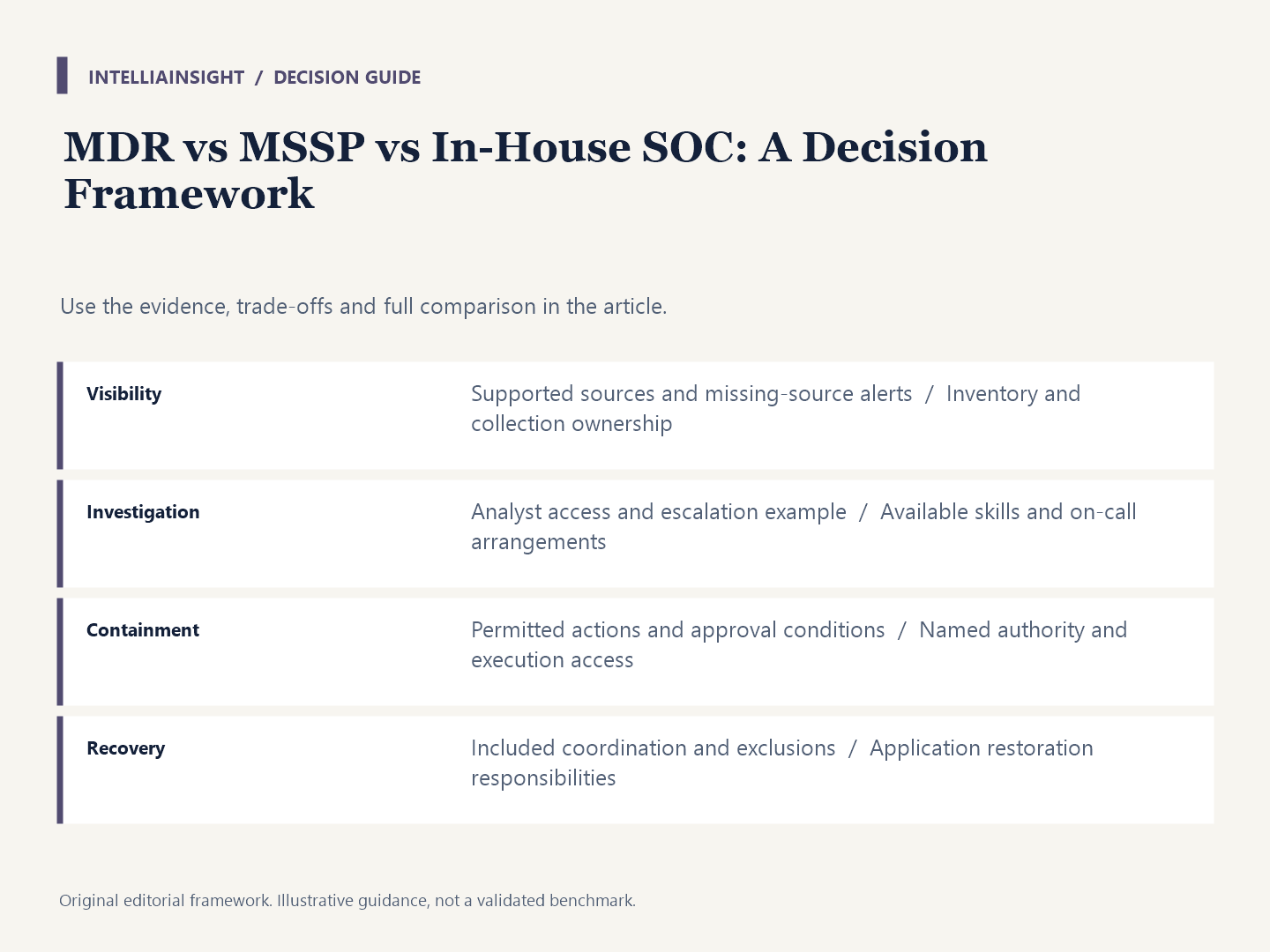
MDR and MSSP offerings overlap. Some include active containment; others provide investigation and escalation, infrastructure management or combinations of these services. An internal SOC can also depend on external technology and specialist support. Write down the actual responsibility split before comparing costs.
Start with the business service
Select a service whose interruption would force an executive decision: customer authentication, order processing or a production application. Map its identities, devices, cloud workloads and external dependencies. Ask which components the proposed service actually monitors, which require additional licences and which remain outside scope.
Use that map as the boundary of the evaluation. Endpoint coverage alone cannot establish visibility into every identity or application event. Conversely, ingesting every available log can create expense without proving that anyone investigates the events that matter. Request a coverage diagram with explicit exclusions and named owners for those exclusions.
The NIST CSF 2.0 release, dated February 2024, added emphasis on governance and supply chains. Use that emphasis to connect the purchase to business risk; the framework does not rank providers.
Compare functions rather than labels
Build a responsibility sheet that every bidder completes using the same service scenario. The following is an editorial buying tool, not a standard definition of these market categories.
| Decision area | External service evidence | Internal SOC evidence | Buyer decision |
|---|---|---|---|
| Visibility | Supported sources and missing-source alerts | Inventory and collection ownership | Accept or close each critical gap |
| Investigation | Analyst access and escalation example | Available skills and on-call arrangements | Identify who supplies business context |
| Containment | Permitted actions and approval conditions | Named authority and execution access | Approve a specific action boundary |
| Recovery | Included coordination and exclusions | Application restoration responsibilities | Fund the retained work |
| Improvement | Rule ownership and change records | Engineering capacity and review queue | Assign tuning and maintenance |
| Exit | Export formats and transition assistance | Documentation and transferable knowledge | Preserve operating continuity |
Require specific answers. “Full response” could mean advising your team, opening a ticket or directly disabling an account. Those are materially different purchases.
Price the retained operating work
Compare total operating cost over the period procurement is evaluating. Include subscription or platform charges, telemetry costs, integration work, internal response coverage, application engineering, exercises and transition expenses. Avoid deducting existing tool costs until someone has confirmed that the replacement covers the functions being removed.
For an internal SOC, calculate staffing from the service hours, escalation design, leave coverage and required skills. A fixed analyst headcount is not a universal formula for continuous operations. For outsourcing, list the people still needed to authorize business disruption, restore services, communicate with customers and validate remediation.
Finance should request a base case and a workload sensitivity case. Explain which charges change when asset numbers, data volume or incident activity increases. Keep operational affordability separate from expected breach savings: a buyer normally cannot establish avoided losses from a short procurement exercise.
Make response time measurable
Distinguish the clocks for event arrival, alert creation, analyst review, customer notification, approval and action. A fast acknowledgement can coexist with a slow investigation. Ask when each clock begins, what pauses it, whose systems record it and which actions occur outside the stated service commitment.
Discuss situations in which the customer cannot be reached. Can the provider isolate a laptop? What about a server supporting payments? Preauthorization should name the asset class and permitted action, alongside the rollback owner and escalation route. It should not become an unrestricted permission to interrupt the business.
NIST SP 800-61 Revision 3, published April 2025, places incident response within wider risk management. That is a useful basis for asking how detection connects to preparation and recovery, rather than treating an alert notification as the finished service.
Learn carefully from a documented response
Cloudflare's account published on 1 February 2024 describes bringing in CrowdStrike's forensic team during its November 2023 incident investigation. This is evidence of internal and external investigation working together in that event.
The account does not establish a universal operating model, purchasing relationship or incident response retainer. It also cannot establish that an external SOC would have prevented the incident. The transferable question is narrower: when should an organisation supplement its own responders, and how will those specialists receive access and context?
Ask bidders to explain how they would cooperate with your separately appointed forensic team. Clarify evidence export, competing action requests and ownership of the incident chronology. Two competent suppliers can still leave a gap if each assumes the other is coordinating recovery.
Run a handoff exercise before selecting
Illustrative scenario: a regional software business has an internal engineer on call and is evaluating an external service. A permitted exercise presents a suspicious identity event associated with a customer-facing application. The evaluation uses synthetic records and agreed actions; it does not require an uncontrolled attack.
The supplier must explain the evidence, identify the affected service and obtain the correct approval. The engineer must locate the application owner and describe the consequence of revoking access. Procurement observes where the contract answers the question and where participants rely on undocumented assumptions.
Record a decision timeline and unresolved ownership gaps. If the supplier requires an integration the buyer does not operate, revise scope and cost before approval. If nobody can authorize the proposed containment, the handoff has failed even when the technical investigation is persuasive. Repeat the relevant part after correcting responsibilities.
Choose exercise duration and success criteria from your operating needs. They are local planning decisions, not industry benchmarks. Require enough repetition to show that the revised process can be used by the people actually on duty.
Keep the model accountable after signing
Make acceptance conditional on evidence that critical sources are connected, missing telemetry is surfaced, escalation contacts work and approved actions can be reversed by the right owner. Document open gaps individually rather than accepting an aggregate completion percentage that hides a critical missing system.
Assign an internal service owner to review material business changes, provider changes and recurring escalation failures. An acquisition, new cloud platform or change in customer support coverage can alter the original decision. Renewal should revisit those assumptions and include the ability to export investigation history.
Keep related governance decisions with the cybersecurity collection. If your organisation sells security technology, the SaaS demand generation campaign brief offers a way to plan buyer education around specific decisions.
For technology vendors struggling to reach the right buying committee, Lidespy's demand generation services can support the marketing challenge. IntelliAInsight is a Lidespy LLP publication.
Sources and research dates
- NIST releases Cybersecurity Framework 2.0 — 26 February 2024.
- NIST SP 800-61 Revision 3: Incident Response Recommendations — April 2025.
- Cloudflare: Thanksgiving 2023 security incident — 1 February 2024; incident November 2023.
Common questions
Does an MDR contract remove the need for an internal security owner?
No. The buyer still needs accountable ownership for scope, business context, containment authority and remediation. The internal workload depends on the purchased service and environment. Ask the provider to demonstrate every handoff, then assign the application, identity and communications responsibilities that remain with your organisation.
Can an MSSP provide containment?
It can, if the specific offering and contract include it. MDR and MSSP labels are insufficient evidence of response powers. Review supported technologies, approval requirements, permitted actions, operating hours and exclusions. Include the proposed containment action in an agreed exercise rather than relying on a product category definition.
What should procurement compare when quotes cover different services?
Normalize the service boundary first: assets, data sources, hours, investigation, response actions and retained work. Then compare cost under the same operating assumptions. Record capabilities that cannot be normalized as explicit differences. A cheaper quote may be reasonable, but only if the buyer knowingly funds and owns the excluded work.
Link to this article
Writing about this? Copy the address, or the ready made link.
Get new stories by email
Join the list and be first to get our best stories when the newsletter starts. One click to unsubscribe.
Comments
No comments yet. Add the first one.