Enterprise LMS vs LXP: Choose Around Learning Workflows
Choose LMS or LXP around assignments, discovery and skill evidence, with a practical workflow and operating-cost evaluation.

Choose an LMS or LXP by tracing an assigned learning obligation, a learner discovery session and a demonstrated skill through the entire workflow. The winning platform is the one that supports those journeys with usable evidence and manageable administration. Product labels alone cannot establish that fit.
Separate the three jobs
For procurement, use working definitions rather than treating category names as fixed specifications. A learning management system commonly anchors assignment and administration; a learning experience platform commonly emphasizes discovery and curation. Individual products can overlap. Request a demonstration against your requirements before assuming either label includes a capability.
The third job, proving capability, deserves its own design. An employee can complete an assigned module, discover useful content and still need supervised practice before performing a task. Identify who observes performance, where their judgment is recorded and what happens after an unsuccessful attempt. Buying a larger catalogue does not resolve an undefined assessment process.
Create a workflow inventory with the learner group, trigger, required evidence, decision owner and downstream system for every priority journey. Separate mandatory assignments from development opportunities so that recommendations cannot obscure an obligation or turn optional exploration into an employee performance signal.
Compare workflows instead of feature totals
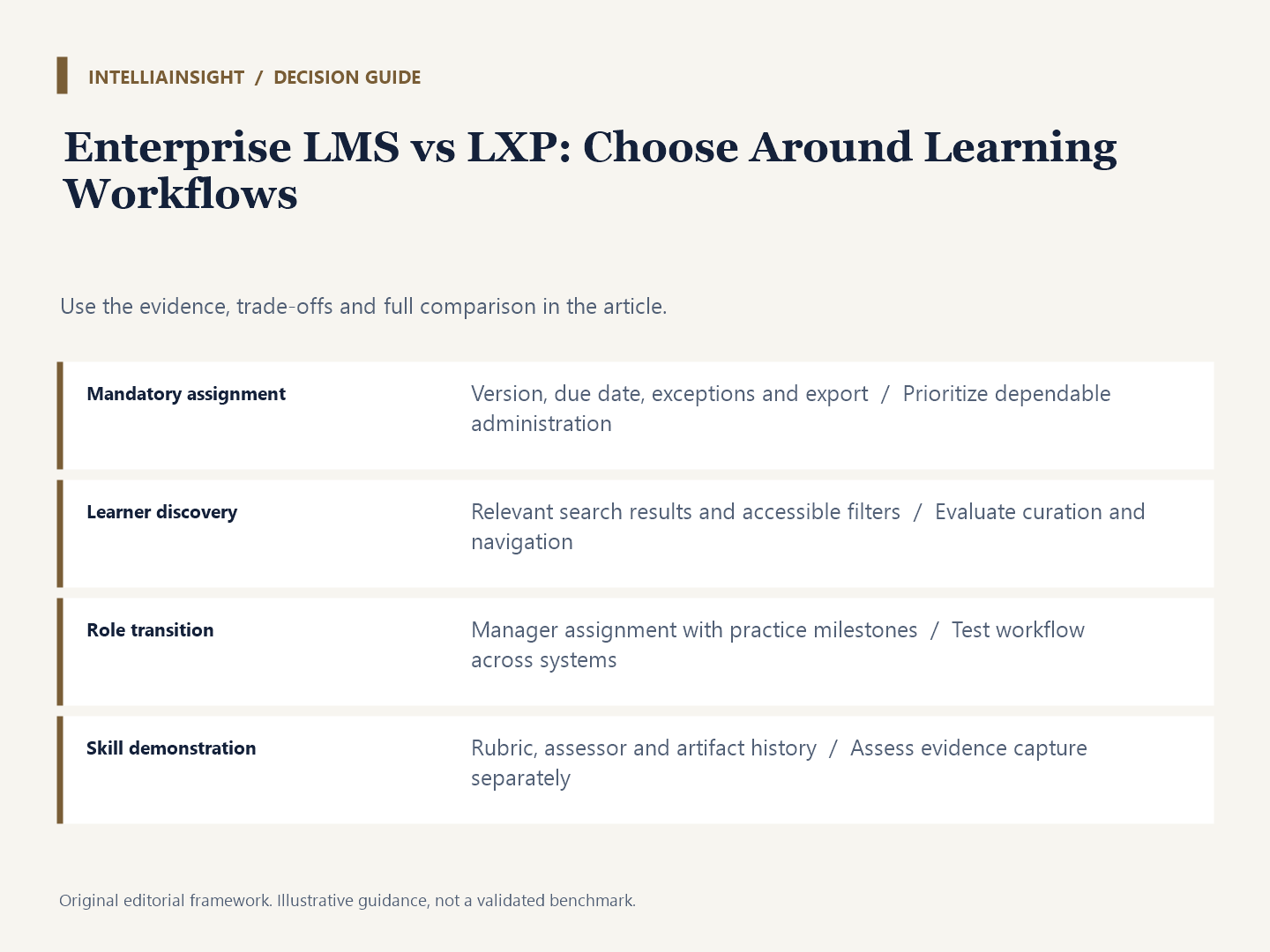
Use this editorial decision table as a demonstration brief. It compares operational needs, rather than claiming universal differences between products. Ask each supplier to complete the same scenarios with your sample content and anonymized organizational structure.
| Workflow | Evidence to request | Selection implication |
|---|---|---|
| Mandatory assignment | Version, due date, exceptions and export | Prioritize dependable administration |
| Learner discovery | Relevant search results and accessible filters | Evaluate curation and navigation |
| Role transition | Manager assignment with practice milestones | Test workflow across systems |
| Skill demonstration | Rubric, assessor and artifact history | Assess evidence capture separately |
| External learner access | Provisioning, support and termination | Check identity and commercial boundaries |
Do not score every row equally. A manufacturer needing documented training assignment may make record integrity a gate. A consulting firm supporting voluntary specialist development may place more weight on discovery. Write that rationale before commercial proposals arrive; otherwise attractive demonstrations can quietly redefine the problem.
Test the whole learner journey
Begin from an invitation on a realistic device. Follow sign-in, language selection, search, enrolment, content access, assessment and support. Include a learner returning after a failed connection and an employee whose role changes during the assignment. Observe how much explanation the evaluator must provide.
Accessibility belongs in this exercise. W3C's WCAG 2.2 Recommendation, in the version dated 12 December 2024, provides testable web accessibility criteria. It does not certify a vendor's complete implementation. Have accessibility specialists scope the platform, authored content, authentication and third-party tools, then record defects and alternatives by journey.
Ask suppliers to distinguish native functionality, configured functionality, partner dependencies and work still requiring development. Capture administrator effort as well as learner effort. A feature that works only when a specialist rebuilds every course can impose a different operating model from the one your procurement team intended to purchase.
Demand an evidence chain for learning claims
Arizona State University's 24 July 2024 account of its OpenAI collaboration described projects including a language-learning buddy. That is a concrete example of institutions experimenting with learning support beyond a conventional course catalogue. The university account does not establish that an LXP outperforms an LMS or demonstrate causal learning improvement.
The transferable question is how a new learning activity connects to the institution's existing environment. Ask how the platform records the activity's purpose, approved content, participant support and assessment result. A conversational learning tool may sit beside either platform category, creating integration and governance work that the category comparison misses.
For any claimed learning outcome, request the population, assessment, comparison, timing and limitations. Completion and positive feedback can support an adoption claim. They do not establish retention, transfer or improved business performance. Keep those evidence levels separate in the evaluation and in the eventual business case.
Work through an illustrative procurement decision
Consider a hypothetical engineering services business with induction obligations, a searchable technical library and supervised equipment troubleshooting. These are illustrative requirements, not a report about a real customer. The team initially prefers one platform because its discovery interface looks easier to use.
The scenario test reveals a different dependency: supervisors cannot record observed troubleshooting attempts without maintaining a separate spreadsheet. Finance therefore compares three designs: an LMS with improved search, an LXP integrated with the existing assignment system, and a single platform plus a specialist assessment workflow. Each design must include supervisor administration and data reconciliation.
The decision worksheet calculates annual operating cost as subscription plus implementation amortization, content maintenance, integration support, administrator time and assessment coordination. Benefits remain separate: fewer duplicate records, reduced search effort and better evidence coverage. Only monetize search time when a credible baseline and usable alternative work exist. Do not count the same administrative saving in multiple systems.
A sensible outcome could be retaining the assignment platform while improving discovery. Another could be replacing both tools. The framework deliberately leaves the result open until the journeys and ongoing operating burden have been demonstrated.
Resolve ownership before integration
Name the authoritative source for employee identity, organizational unit, course version, assignment status and assessment evidence. A single field can have several consumers while retaining one accountable owner. Document update timing and reconciliation when the learning platform receives delayed or contradictory information.
Test events that expose ownership: a leaver with outstanding assignments, a returning contractor, a merged department and a changed course version. Verify whether historic records retain their original meaning. An export of current completions cannot reconstruct an audit trail if earlier assignments and versions disappear.
The contract should identify support responsibilities across the platform provider, identity supplier and implementation partner. Agree how content and records can be exported in interpretable formats, including attachments and assessment rubrics. Test a small export before signature and price the work required to make the data useful elsewhere.
Make the final recommendation reviewable
Present a short decision record showing the critical workflows, unresolved failures, expected operating cost and named owners. Distinguish acceptable inconvenience from a failed requirement. Avoid averaging away an inaccessible assessment or unreliable mandatory-assignment record with high scores for recommendation features.
Set an adoption review around evidence the buyer can collect: successful independent task completion, administrative workload, exception resolution and coverage of required learning records. Choose the observation period to match actual learning opportunities; a calendar deadline alone cannot prove capability transfer.
Continue with our EdTech and learning technology coverage. Vendors explaining an overlapping product category can use the SaaS demand generation campaign brief to connect each buyer role to the evidence it needs.
For learning technology vendors, an optional next step is Lidespy's content syndication services for distributing useful buyer evidence. IntelliAInsight is a Lidespy LLP publication.
Sources and research dates
- Web Content Accessibility Guidelines (WCAG) 2.2 — 12 December 2024 Recommendation; WCAG 2.2 first became a Recommendation 5 October 2023.
- ChatGPT Edu, fall 2024 and more: Dive into ASU’s collaboration with OpenAI | ASU Enterprise Technology — 24 July 2024.
Common questions
Can an LXP replace an LMS?
Possibly, if it demonstrates every required assignment, record, access and reporting workflow. Evaluate the actual product configuration and dependencies. If mandatory administration depends on an additional system, include its cost and support responsibilities rather than treating the LXP subscription as the complete solution.
How should we evaluate AI recommendations?
Inspect relevance for different roles, languages and experience levels, then check what data shapes recommendations. Give learners ways to find required content and challenge irrelevant suggestions. Recommendation click rates indicate interaction; use independent assessment to evaluate whether recommended learning helps people perform the intended task.
What should a pilot prove?
It should prove that learners and administrators can complete priority journeys with the intended support model. Include accessibility, changed roles, export and failed connections. Select the sample and duration around real workflow variation, and define unacceptable failures before testing rather than adopting a universal pass percentage.
Link to this article
Writing about this? Copy the address, or the ready made link.
Get new stories by email
Join the list and be first to get our best stories when the newsletter starts. One click to unsubscribe.
Comments
No comments yet. Add the first one.