Healthcare Interoperability: A Procurement Checklist
Workflow-specific exchange, semantic mapping and acceptance testing; distinguish standards support from usable integration.

Procure healthcare interoperability by specifying a complete information exchange for a named workflow. Identify the sender, recipient, data meaning, identity checks, operating owner and failure response. A supported standard or available interface is starting evidence; acceptance requires showing that the receiving team can use the information correctly.
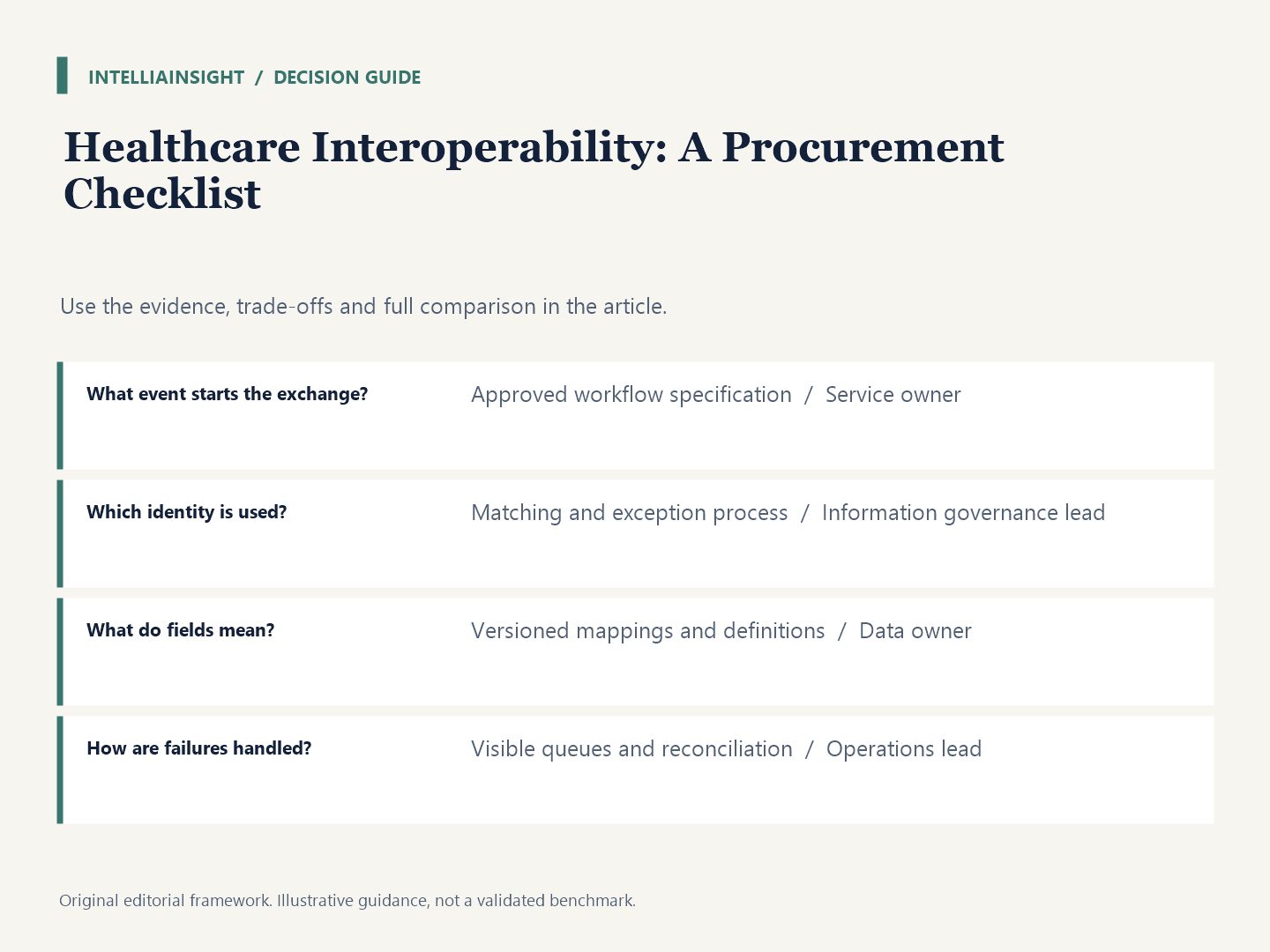
This is general procurement and governance education for health technology buyers. Local clinical, information governance, security and legal specialists should determine applicable requirements. The proposed checklist is an editorial decision tool, rather than a technical certification or a promise of clinical benefit.
Describe the exchange in operating terms
Choose a bounded workflow such as transferring an approved referral document, updating an appointment status or making a reviewed record available to an authorised team. Name the originating event and the point at which the recipient considers the exchange complete. Avoid beginning with an organisation-wide requirement to connect everything.
Document what users currently do when information arrives late, incomplete or in an unexpected format. That workaround belongs in the baseline. An integration can move data faster while leaving staff to interpret unresolved meaning or identify the correct patient. Those tasks remain part of the proposed workflow cost.
The OECD working paper published 24 July 2026 frames interoperability across people, policy, processes and technology in OECD settings. It supports a broad procurement perspective; it does not establish that any supplier's standards support produces a functioning local exchange.
Turn a standards claim into an acceptance worksheet
| Procurement question | Evidence to request | Acceptance owner | Important limitation |
|---|---|---|---|
| What event starts the exchange? | Approved workflow specification | Service owner | A demo trigger may differ from production |
| Which identity is used? | Matching and exception process | Information governance lead | Matching needs local assessment |
| What do fields mean? | Versioned mappings and definitions | Data owner | Similar labels may conceal differences |
| How are failures handled? | Visible queues and reconciliation | Operations lead | A successful send is not receipt |
| Who can access or change data? | Permission and audit evidence | Security and system owners | Interface capability is not authorisation |
| Can the exchange be maintained? | Version, support and exit plan | Integration owner | Future upgrades may require work |
Complete the worksheet jointly with the receiving service. Buyers should not delegate semantic acceptance entirely to the supplier that builds the connection. The people relying on the information need a practical way to inspect whether it retains its intended meaning.
Specify what remains outside scope. An interface might carry a document without mapping its contents into structured fields. That can still be useful, but the contract and business case should describe the actual function. Do not price unimplemented downstream automation as a realised benefit.
Test meaning as carefully as movement
Create representative approved test records that exercise the distinctions the workflow depends on. Ask responsible specialists to select them and determine expected handling. Include missing fields, changed identifiers, corrected records and values whose units or dates could be misinterpreted. Avoid exposing personal information unnecessarily during procurement.
Compare source, transformation and receiving-system display. Preserve the mapping version and any manual decisions needed to interpret the result. A field that arrives intact may still appear under an unsuitable heading or lose the context that made it useful. The acceptance record should capture that distinction.
When teams disagree about a definition, assign a data owner to resolve it before retesting. More connector configuration cannot decide an unresolved operating rule. Keep unresolved questions visible in the procurement decision instead of treating every transmitted field as an accepted requirement.
Examine the receiving workflow and its permissions
Ask the receiving team to complete the task without assistance from the demonstrator. Observe navigation, review, acknowledgement and correction. Establish whether information enters a review queue, becomes a draft or changes an authoritative record. These states need different permissions and evidence.
NHS England's ambient scribing guidance, updated 29 July 2026 includes integration and output review considerations for England. Its specific setting should remain explicit. A procurement team elsewhere should assess local requirements rather than treating English guidance as a universal legal determination.
The GOSH account dated 4 September 2025 describes a London AI-scribe study in which clinicians reviewed drafted documentation before saving it. That organisation-reported application illustrates a review handoff, not proof that any other interface is safe or interoperable.
Rehearse failure and reconciliation
Use an approved environment to test interrupted delivery, duplicate events, corrected records and an unavailable recipient. Let specialists define the appropriate tests. Record who sees the failure, who decides what to do and how the final state is reconciled. A silent backlog can undermine an otherwise successful demonstration.
Distinguish retrying a transmission from confirming that it should still be processed. A delayed update may no longer reflect the current state. The relevant operational and technical owners need to establish handling rules, including when human review is required. Procurement should request evidence of those agreed rules.
Test the support boundary between suppliers. If the source vendor says the message left successfully and the receiving vendor says nothing arrived, the service still needs an owner. Include incident coordination, evidence access and escalation responsibility in commercial terms.
Calculate the work the integration leaves behind
Consider a hypothetical referral-document exchange handling one hundred weekly items. Assume manual transfer currently takes six minutes per item. The new connection reduces routine handling to two minutes, but twenty exceptions each require eight additional minutes. These invented values are illustrative planning assumptions.
Total proposed handling becomes three hundred and sixty minutes, compared with six hundred before the connection. The resulting four hours of weekly capacity is not automatically a cash saving. Subtract mapping maintenance, reconciliation and support effort, then identify whether released time can be used in the service.
Report distribution as well as totals. An integration may reduce work for the sending team while increasing clarification demand for the recipient. Ask both teams to sign off the business case and explain who funds the recurring exception workload.
Contract for a maintained exchange
Attach the workflow, mapping versions, test results, known limitations, support ownership and change process to the acceptance decision. State which upgrades require review and how suppliers notify buyers about changes. Include data export and transition assistance so records remain usable after replacement.
Choose expansion conditions before adding more flows. Evidence from one document exchange does not automatically validate a different service or data type. Preserve the useful architecture while repeating the acceptance work that the new context requires. A smaller maintained exchange can be more valuable than a large catalogue of unowned connections.
Follow our healthcare technology coverage and B2B technology coverage. IntelliAInsight is a Lidespy LLP publication. HealthTech vendors explaining integration evidence to buying committees can explore Lidespy's B2B demand generation services.
Sources and research dates
- Interoperability in healthcare | OECD — 24 July 2026.
- NHS England » Guidance on the use of AI-enabled ambient scribing products in health and care settings — Updated 29 July 2026.
- GOSH-led trial of AI-scribe technology shows ‘transformative’ benefits for patients and clinicians across London | Great Ormond Street Hospital — 4 September 2025.
Common questions
Does support for a healthcare data standard prove interoperability?
No. Buyers still need to examine the supported version, local configuration, field meanings, identity handling and receiving workflow. Ask for a representative exchange with acceptance by both services. A connector can transmit information successfully while leaving staff to resolve missing context or operational exceptions.
Who should approve an integration before purchase?
The service owner, receiving users, data owner and relevant technical and assurance specialists should approve the parts they understand and own. Responsibilities can sit with fewer people in a smaller organisation. Avoid letting one project manager sign for clinical, semantic and technical questions without the appropriate review.
Should procurement require every possible interface at launch?
Prioritise the exchanges needed for the initial operating decision, and document future dependencies separately. Each connection requires maintenance and acceptance evidence. A roadmap can support planning, but an unimplemented interface should not be counted as a delivered capability or included in realised benefit calculations.
Link to this article
Writing about this? Copy the address, or the ready made link.
Get new stories by email
Join the list and be first to get our best stories when the newsletter starts. One click to unsubscribe.
Comments
No comments yet. Add the first one.