Construction AI: Choose a Pilot That Survives the Jobsite
Select a bounded workflow, count field effort and trace AI results to project evidence.

Choose a construction AI pilot around one decision that a site team can verify. A system can produce an attractive progress summary and still fail operationally if supervisors must reconstruct its evidence every evening. Start with a bounded workflow, identify the person accepting its output and measure the entire chain from capture to correction.
The RICS report published 18 August 2026 draws on more than 3,100 professional responses across construction and commercial property. Its observation that embedded use remains uncommon supports distinguishing experimentation from an operating process. It does not establish the effectiveness of a particular product on your projects.
Write the decision before selecting a vendor
Describe the proposed workflow in one sentence: the planner identifies activities requiring verification before tomorrow's coordination meeting; the document controller finds references relevant to a request for information; or the estimator checks whether an item appears in the supplied tender package. Each sentence names a user, input, output and decision point.
A proposal to introduce AI throughout the company cannot establish what a useful result looks like. Separate suggestions from actions. Finding a possible drawing conflict carries different permissions from issuing an instruction, approving payment or changing the accepted programme. Document the permissions of integrations as well as the interface visible to users.
Compare the present workaround, an ordinary search or rules-based improvement, and an AI option. Repairing inconsistent revision labels may remove more friction than adding a model over the same records. A defensible pilot can conclude that the simpler intervention is sufficient.
Use a field burden and evidence worksheet
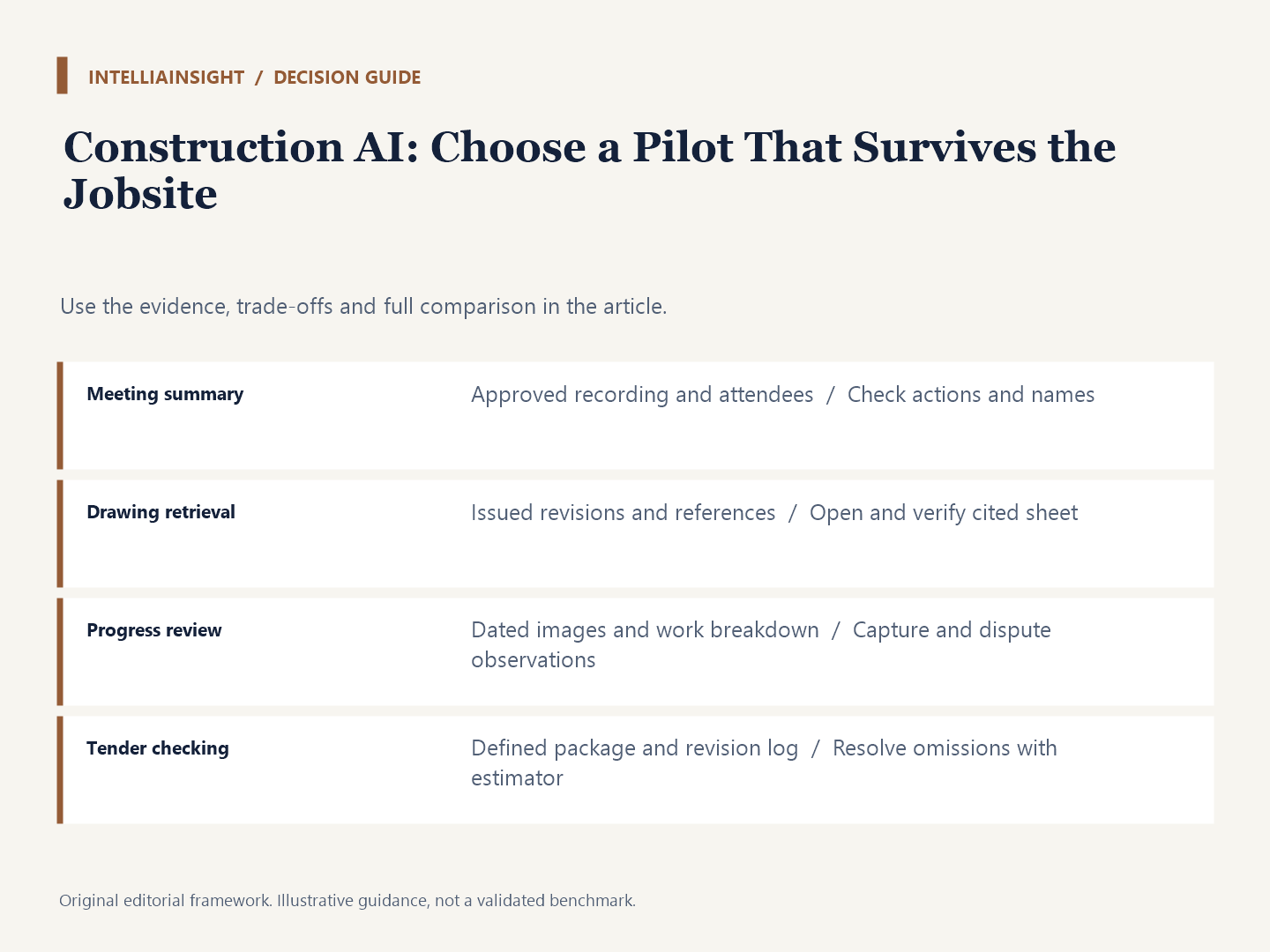
The following editorial worksheet is a discussion aid, not an industry scoring standard. Complete it with the site lead and output owner. Do not average a serious evidence failure into a high overall score.
| Workflow | Required evidence | Added field work | Starting permission | Reason to defer |
|---|---|---|---|---|
| Meeting summary | Approved recording and attendees | Check actions and names | Draft only | Capture process is unapproved |
| Drawing retrieval | Issued revisions and references | Open and verify cited sheet | Return references | Withdrawn drawings appear current |
| Progress review | Dated images and work breakdown | Capture and dispute observations | Flag for inspection | Hidden work is treated as visible completion |
| Tender checking | Defined package and revision log | Resolve omissions with estimator | Suggest discrepancies | Output is treated as priced scope |
| Programme commentary | Accepted schedule and updates | Reconcile exceptions with planner | Draft commentary | Suggested changes alter commitments |
For every workflow, ask what happens when evidence is missing. An explicit unavailable result may be more useful than a plausible answer. Request a demonstration with an ambiguous input and a withdrawn revision, rather than relying exclusively on polished vendor examples.
Make traceability an acceptance condition
A progress observation might carry a project identifier, capture time, source reference, relevant revision and review status. Fields depend on the task; the principle is that another authorised person can reconstruct the observation without relying on the original operator's memory. Include this requirement in the pilot agreement.
Crossrail's July 2018 BIM learning legacy describes models linked to databases and information workflows supporting construction and handover. This historical project account illustrates information architecture. It is not a test of contemporary AI or evidence of a transferable financial return.
A smaller contractor can borrow reference discipline without copying the programme's architecture. Require answers to link to the issued drawing in the existing document system. Investigate who maintains those links when drawings change and when a subcontractor leaves. Purchasing another platform does not assign that responsibility automatically.
Calculate useful time after correction
Consider an explicitly illustrative weekly drawing-retrieval pilot. Assume 100 questions currently take eight minutes each: 800 minutes. With the tool, initial retrieval takes three minutes and source checking takes two. Assume 20 ambiguous results each need six additional minutes. Total effort becomes 100 × 5 + 20 × 6 = 620 minutes. The visible retrieval improvement produces a net saving of 180 minutes.
Now assume uploading and labelling documents adds four hours weekly. Total effort becomes 860 minutes, worse than the baseline. These invented assumptions are not prices, performance forecasts or acceptance thresholds. The example shows why maintenance, capture and exceptions belong in the same ledger as time saved at the interface.
Finance should distinguish released capacity from cash. Three saved hours are not a payroll saving unless staffing or purchased overtime changes. The site manager might instead use the capacity for coordination. Name that intended use, then check whether the change occurs rather than valuing every minute as recoverable expenditure.
Observe conditions that could invalidate the result
Include revision changes, intermittent connectivity, different trades and incomplete evidence in the evaluation design. These are coverage dimensions rather than a universal sample prescription. The sponsor and relevant professional should determine coverage from the decision's consequences and variability. A narrow pilot can establish usability without establishing performance on every project type.
Keep a paired exception log: proposed output, accepted output, correction, reason and effort. Distinguish incorrect source data, an erroneous response and an unclear business rule. Each requires a different remedy. More model tuning cannot resolve the absence of an authoritative drawing.
Retain the approved workflow until replacement is authorised. Suspend an affected function when its evidence cannot be accessed or a material error cannot be traced. Set escalation rules with the responsible professionals. A generic acceptable-error percentage is unsuitable when different errors have very different consequences.
Give site teams ownership of expansion evidence
Assign a site champion with protected time, a process owner able to change the workflow and a technical owner responsible for permissions and integration. These are responsibilities rather than necessarily three positions. Ask subcontractors what device access, language support and working arrangements make participation practical. A pilot cannot demonstrate field adoption when office staff quietly complete every submission.
Before expanding, compare people who used the system with those who declined or needed help. Review abandoned tasks and reasons for workarounds, not only average satisfaction. The expansion proposal should show recurring support demand, remaining exceptions and project types to which the evidence does not transfer.
Require a sponsor to choose between expanding, redesigning or closing the pilot. Closing a technically impressive experiment can be a successful decision if its operating burden exceeds its benefit. Record reusable findings about data ownership and field workflow so the next proposal does not repeat the same discovery work.
Our construction technology coverage connects these decisions to procurement and handover. For vendors preparing proof for such buyers, the SaaS demand generation campaign brief helps connect a specific operational problem to a useful evidence asset. IntelliAInsight is a Lidespy LLP publication; technology vendors can explore Lidespy's B2B demand generation services.
Sources and research dates
- AI in commercial property and construction report 2026 — 18 August 2026.
- Crossrail Project: Application of BIM (Building Information Modelling) and Lessons Learned - Crossrail Learning Legacy — 9 July 2018.
Common questions
Should the first pilot involve a live project?
A live project can expose capture and review burdens that demonstrations miss. Begin with bounded permissions and an approved fallback. Use historical or simulated material first where errors could affect safety, payment or contractual commitments, and let responsible project professionals decide when live use is appropriate.
How should we choose the pilot duration?
Choose a period containing the events you need to observe, such as a drawing revision, subcontractor handoff or reporting cycle. A deadline alone is weak evidence. Record which conditions occurred, which remain untested and whether additional observation would change the expansion decision.
Does individual AI usage count as enterprise adoption?
Individual use can demonstrate interest and reveal useful tasks. An operating process also requires approved data handling, maintained integrations, accountable review and support. Ask whether the workflow would continue if its enthusiastic early user left the project. If that is unclear, adoption still depends on individual effort.
Link to this article
Writing about this? Copy the address, or the ready made link.
Get new stories by email
Join the list and be first to get our best stories when the newsletter starts. One click to unsubscribe.
Comments
No comments yet. Add the first one.