AI Lead Scoring: Build a Test That Measures Pipeline
AI lead scoring is useful when it helps a sales team spend its limited time on better opportunities.

AI lead scoring is useful when it helps a sales team spend its limited time on better opportunities. Evaluate it against that operating decision, using records the model could genuinely have seen at the time. A high accuracy score on an exported CRM spreadsheet can be misleading if it includes information added after qualification or ignores leads that never received attention.
The decision belongs jointly to marketing operations and sales operations. Marketing needs to understand which inquiries become useful conversations; sales needs a queue it can actually work. Finance should be able to follow the link between prioritization, selling effort and commercial outcomes.
Define what the score is supposed to change
Start with one use. Are you deciding which inbound inquiries receive a fast human response, which accounts deserve additional research or which product users may be ready for an enterprise discussion? These are different decisions. Combining them into a single “propensity” score makes it difficult to identify a useful target or evaluate failure.
Define the outcome in language operators can audit. “Sales accepted a relevant inquiry” is different from “an opportunity was created” and different again from “the customer paid.” The farther downstream the outcome, the longer you must wait and the more intervening decisions affect it. Choose a target that reflects the score’s intended action without pretending the model controls the whole revenue process.
Document what happens when the score changes. If nobody can describe how a seller’s queue or response process would differ, the project may be producing another reporting field rather than an operational improvement.
Separate fit, evidence and timing
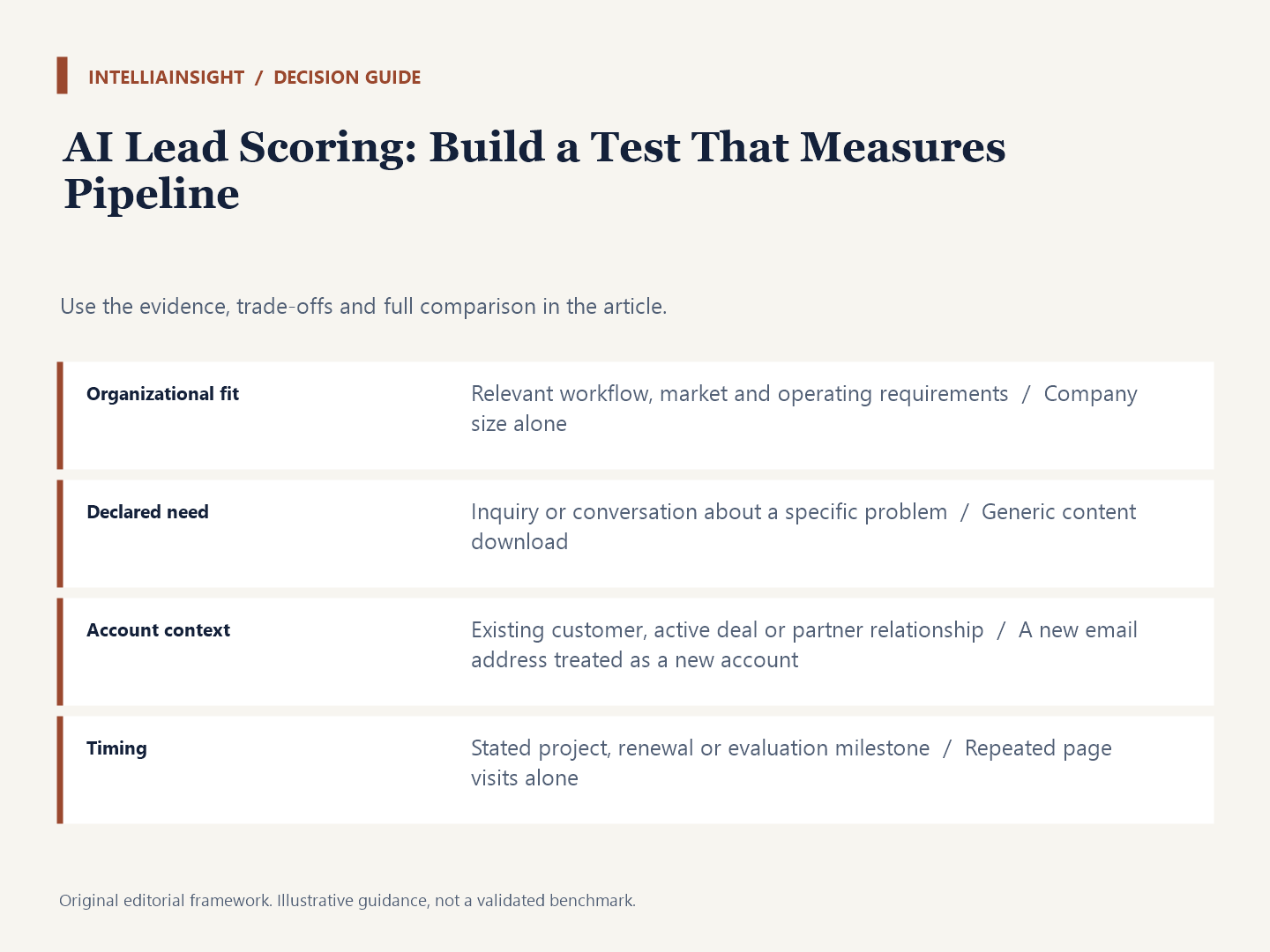
Our editorial scoring worksheet keeps three questions separate: can this organization benefit from the offer, what evidence of a relevant need exists, and is there a useful action now? A blended number may still help sort a queue, but operators should be able to inspect those components and the missing information behind them.
| Component | Useful evidence | Common misleading substitute | Operational response |
|---|---|---|---|
| Organizational fit | Relevant workflow, market and operating requirements | Company size alone | Confirm the use case |
| Declared need | Inquiry or conversation about a specific problem | Generic content download | Ask a useful follow-up question |
| Account context | Existing customer, active deal or partner relationship | A new email address treated as a new account | Route to the relationship owner |
| Timing | Stated project, renewal or evaluation milestone | Repeated page visits alone | Verify the next decision |
| Confidence | Traceable evidence and known missing fields | A precise-looking score | Escalate uncertainty appropriately |
These are editorial categories, not a validated scoring standard. Their value is that they make disagreements visible. A seller can challenge an account classification or a stale timing signal instead of rejecting an unexplained number.
Prevent information from the future entering the test
Build a training and evaluation timeline before fitting a model. Record when a feature became available, not just whether it exists in today’s CRM. A field such as “discovery completed” can be highly predictive because it records the result of a seller’s work. It is not necessarily available when a new inquiry first enters the queue.
Use an earlier period to develop the model and a later period to assess it. Keep company and account relationships in mind when splitting records: near-duplicate contacts from one opportunity can otherwise appear on both sides of a test. Include the rules that were in force during each period, such as territory changes or a new qualification definition.
The NIST AI Risk Management Framework, released in 2023, is a useful broader reference for documenting context, measurement and accountability. It does not prescribe a particular marketing model or certify your score. The practical requirement here is an evaluation someone outside the model team can reconstruct.
Compare scores at the team’s actual capacity
A model can look impressive across an entire dataset while being unhelpful at the top of the sales queue. Evaluate the portion your team can work, and compare it with the current routing approach under similar conditions. Keep the amount of human attention comparable.
Consider an illustrative team able to research 100 of 1,000 new account inquiries. Suppose the current approach identifies 20 accepted opportunities from those 100, while the new score identifies 25. That is five additional accepted opportunities in the worked example, not proof of five incremental sales. Check whether acceptance standards, account mix and seller effort stayed comparable before attributing the difference to the score.
Now include cost. If the new queue requires substantially more research or produces opportunities sellers subsequently reject, the initial gain may disappear. Keep rejection reasons, correction time and later progression beside the acceptance count. The decision should reflect the value of the queue, rather than rewarding the model for selecting easy-to-label records.
Observe what happens when humans use the output
Historical testing cannot reproduce every effect of deployment. Sellers may ignore low scores, which means those leads receive less attention and generate less evidence. Retraining on that pattern can reinforce the original routing decision. A controlled operational trial should therefore preserve a way to inspect a comparable sample outside the preferred queue.
The trial design depends on the business. Random assignment may be practical for similar inbound inquiries, while account-level assignment can reduce interference when multiple contacts belong to one buying group. Agree the design with someone able to assess sample size, uncertainty and commercial constraints. Avoid presenting a small difference as a settled result.
Record overrides as information. A seller who routes an apparently weak account to an existing account owner may be applying context the model lacks. Capture the reason and review whether the feature set or workflow should change. Do not treat every override as resistance to automation.
Use real deployments as workflow examples
In its 15 October 2024 customer account, Microsoft describes Schneider Electric using sales assistance with Salesforce inside communication tools. This is a vendor-published example of embedding assistance in existing work, not independent validation of a lead-scoring model.
The transferable question is whether sellers can see and correct relevant information where they already act. For a scoring pilot, that might mean a short explanation, its source and a routing reason alongside the CRM record. A separate dashboard may be less useful if operators must leave their queue to interpret every recommendation.
Decide how the score will be maintained
Assign an owner for feature definitions, one for routing and one for review of commercial outcomes. Keep a change log when the offer, target market or sales process changes. A score trained around one product or region should not silently become the default for another.
Set review triggers around meaningful changes: deteriorating queue quality, repeated unexplained overrides, missing data or a changed qualification process. The thresholds are your operating choices and should reflect the cost of errors. Provide a fallback routing rule so that withdrawing a model does not leave inquiries without an owner.
Start with CRM data hygiene if your definitions or account records are inconsistent. Our intent data evaluation explains why a signal needs context before it becomes a buying conclusion. Related reporting appears in AI in Marketing & Sales.
For SaaS vendors, the same discipline helps clarify which audiences and campaign responses are worth developing. Explore Lidespy’s audience intelligence and demand generation services when the next challenge is reaching relevant buying groups. IntelliAInsight is a Lidespy LLP publication.
Sources and research dates
- NIST AI Risk Management Framework, released in 2023 — AI RMF 1.0 released 26 January 2023; current page accessed 13 November 2026.
- 15 October 2024 customer account — 15 October 2024; vendor-published customer account.
Common questions
Should a lead score replace sales qualification?
Usually, the score should prioritize an action or organize evidence. Qualification still needs a clear definition and an accountable owner. If automation makes a qualification decision, document its authority, supporting evidence, uncertainty and escalation route rather than treating the number itself as proof.
How much historical data is enough?
There is no universal record count. Relevant outcomes, consistent labels, changing processes and the frequency of the event matter as much as volume. Review representativeness and uncertainty with an appropriate analyst, and consider whether a simple routing rule offers a more testable starting point.
What should a vendor demonstrate before a purchase?
Ask for an explanation of the target outcome, when features become available, evaluation splits and performance at your queue capacity. Also inspect missing-data behavior, account deduplication, override records, access controls and the fallback process. A demonstration should include difficult records, not only successful examples.
Put this into a SaaS campaign
Connect your targeting, outreach and reporting in one plan. Our B2B SaaS demand-generation guide includes a campaign brief you can download without signing up.
Link to this article
Writing about this? Copy the address, or the ready made link.
Get new stories by email
Join the list and be first to get our best stories when the newsletter starts. One click to unsubscribe.
Comments
No comments yet. Add the first one.