AI Sales Agents: A Buyer’s Guide to Safe Automation
A practical way to evaluate permissions, exceptions and operating costs before giving sales software authority to act.
For revenue operations leaders, the useful buying question is specific: which part of the sales workflow becomes more reliable, and who handles the exceptions? Faster activity has little value when it creates duplicate contacts, unsupported promises or more work for account executives.
Separate the task from the permission
The labels “assistant” and “agent” are inconsistent across products. Evaluate the actual permissions instead. A tool that summarizes a meeting might also create contacts or synchronize notes. A research feature might send information to a separate provider. Ask the vendor to demonstrate the data path and action boundary for each proposed use.
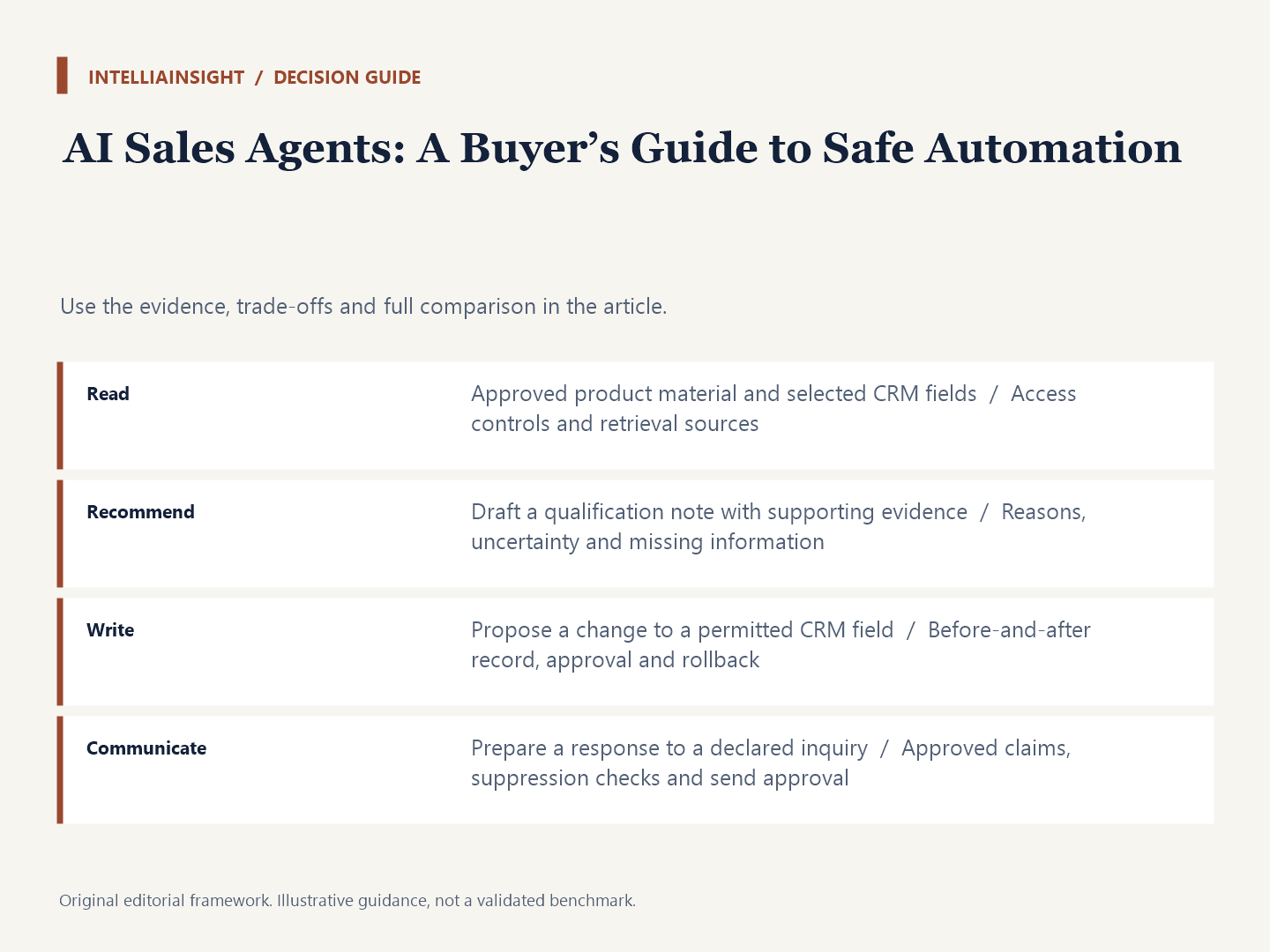
Evaluate four operational permissions: read, recommend, write and communicate. The final row, Commit, is a separate commercial approval decision reserved for the account owner. They describe increasing operational authority, rather than a maturity ladder every organization should climb. Keeping a workflow at the recommendation level can be the right long-term decision when judgment matters or mistakes are expensive to reverse.
| Action | Useful starting scope | Evidence to request | Escalation owner |
|---|---|---|---|
| Read | Approved product material and selected CRM fields | Access controls and retrieval sources | Systems administrator |
| Recommend | Draft a qualification note with supporting evidence | Reasons, uncertainty and missing information | Sales operations |
| Write | Propose a change to a permitted CRM field | Before-and-after record, approval and rollback | CRM owner |
| Communicate | Prepare a response to a declared inquiry | Approved claims, suppression checks and send approval | Sales manager |
| Commit | Quote a price or make a contractual promise | Explicit commercial authority and human sign-off | Account owner |
Treat this matrix as a starting worksheet, not an industry standard. Add your own fields, regions and approval rules. In particular, distinguish recommending a pipeline stage from moving an opportunity into that stage: the latter changes reporting and may trigger other automation.
Ask the vendor to show the difficult cases
Prepare a small evaluation set from redacted historical inquiries. Include ambiguous requests, duplicate companies, existing customers, unsubscribed contacts and messages that contain conflicting instructions. Use synthetic records where personal or commercial information cannot be shared. The purpose is to observe boundaries, not to upload your entire customer database for a sales demonstration.
Ask the vendor to run the same cases in front of the people who would operate the system. Record what information the agent accessed, what it inferred, what it changed and how a human could intervene. A polished answer is only one part of the result. An unexplained field update or an unavailable audit trail can matter more than fluent writing.
Test refusal and uncertainty as well. When a prospect has not stated a budget, a useful agent should preserve that unknown rather than invent a plausible figure. When product documentation conflicts, it should show the conflict or escalate. Decide which uncertainties may proceed to a person and which must prevent an action.
The NIST AI Risk Management Framework, released in 2023, provides a broader risk-management reference. Our action matrix applies that general concern with accountable use to a particular sales workflow; it is not a NIST certification or a replacement for your organization’s assessment.
Learn from a real implementation without copying its claims
In a Microsoft customer account dated 15 October 2024, Schneider Electric used Copilot for Sales with Salesforce, including contact creation and meeting summaries inside its communication workflow.
That is a vendor-published implementation example. It does not establish that every deployment is read-only, that the same benefits will appear in your team or that a particular configuration meets your obligations. The practical lesson is about placement: test whether assistance fits the places sellers already work, then examine the permissions behind that convenience.
For example, compare two operating designs. In one, a seller reviews a proposed contact record before it reaches the CRM. In another, the agent creates the record immediately and a steward cleans up errors later. Both may look efficient in a demo. Their costs differ once you include review time, duplicate resolution and any downstream sequences triggered by a new record.
Run a pilot with a deliberate containment boundary
Begin with a workflow whose impact you can observe and reverse. An illustrative starting point is drafting responses to a limited group of inbound product inquiries, with a human approving every send. The scope and duration should follow your volume, risk and review capacity; there is no universal number of interactions that makes an agent safe.
Before enabling it, document the existing process. Measure response delay, correction work, routing quality and the proportion of inquiries that reach an appropriate next step. Keep a record of how these measures are defined. A change in lead mix can otherwise make the pilot appear better or worse without any change in the agent.
Evaluate outputs at the task level. Was the product claim supported? Was the contact eligible for that message? Did the routing preserve an existing account relationship? Could the operator find the original evidence? Separate severe errors from cosmetic edits instead of hiding both inside one average accuracy score.
Pause the relevant action when an agreed severe failure occurs. Examples include an unauthorized send, exposure of restricted information or a commercial commitment outside the agent’s authority. Investigate the trigger, repair the control and repeat the affected cases before restoring permission. The objective is a workable operating process, including how it fails.
Calculate the workload the agent leaves behind
Consider an illustrative team handling 200 inquiries in a month. Suppose a manual first response takes six minutes, while reviewing an agent’s draft takes two. The simple estimate is 800 minutes of capacity released: 200 multiplied by four minutes. These figures are planning assumptions, not observed results or a market benchmark.
Now add exceptions. If 30 inquiries need an extra ten minutes of investigation, 300 minutes disappear from that estimate. Monitoring, administration and quality reviews consume more capacity. Some time may become available for useful selling without reducing payroll expenditure. Call it capacity until you have evidence that it changes cost or revenue.
Build the business case around that remaining work. Ask whether exception handling fits the sales team’s skills, whether specialists become a bottleneck and whether the software’s price changes with volume. Compare a draft-only design with an autonomous design using the same inquiries. Greater permission should produce a clear operational benefit, rather than simply a higher activity count.
Decide what evidence would justify expansion
Expansion should answer a new question. Moving from one product to another tests knowledge coverage. Entering another market tests language, buying context and local requirements. Allowing an automatic write tests the consequences of changed records. Treating all three as a single rollout makes it difficult to identify the source of a failure.
Keep the commercial owner, systems owner and reviewer accountable for their respective decisions. Obtain agreement on permitted actions, support responsibilities, access removal and data export before signing a longer contract. Request a demonstration of revoking access and stopping queued actions, not simply a description of a “human in the loop.”
If the underlying records are unreliable, start with CRM data hygiene. If automated messages are in scope, review email sender practices alongside your permission and suppression processes. More reporting on related buying decisions appears in AI in Marketing & Sales.
Technology vendors can use this evaluation structure to create clearer product evidence for buyers. If reaching the right B2B buying groups is the next challenge, explore Lidespy’s audience intelligence and demand generation services. IntelliAInsight is a Lidespy LLP publication.
Sources and research dates
- NIST AI Risk Management Framework — AI RMF 1.0 released 26 January 2023; current page accessed 13 November 2026.
- Microsoft customer account dated 15 October 2024 — 15 October 2024; vendor-published customer account.
Use the AI Sales Agent Evaluation Scorecard to record the evidence from each vendor demo.
Common questions
What is the primary operational difference between a research assistant and an AI sales agent?
A research assistant operates in read-only mode to summarize data, transcribe meetings, and provide internal insights without altering external systems. An autonomous sales agent possesses execution privileges, allowing it to modify CRM records, score leads, and send outbound communications directly to prospective buyers.
How can revenue operations teams prevent AI sales agents from corrupting CRM data?
Revenue operations teams must enforce an action-permission matrix that restricts write access, mandates human-in-the-loop review for field updates, and requires rigorous shadow testing against mirrored data before granting autonomous execution privileges in production environments.
What validation metrics should be tracked during an AI sales agent pilot?
Pilots should track lead response latency, field accuracy against human-entered baselines, shadow output discrepancy rates, and the frequency of unauthorized state changes or hallucinated data entries before moving from sandbox testing to live customer engagement.
Put this into a SaaS campaign
Connect your targeting, outreach and reporting in one plan. Our B2B SaaS demand-generation guide includes a campaign brief you can download without signing up.
Link to this article
Writing about this? Copy the address, or the ready made link.
Get new stories by email
Join the list and be first to get our best stories when the newsletter starts. One click to unsubscribe.
Comments
No comments yet. Add the first one.