Manufacturing AI: Choose a Use Case with Measurable Value
Choose manufacturing AI around a production constraint, a usable intervention and a business outcome that operations and finance can verify.
Choose a manufacturing AI use case by identifying a production constraint, a decision someone can change and an outcome finance can verify. Start with the process loss and compare AI with simpler remedies. A technically impressive prediction has little operating value when the plant cannot act on it.
Find the constraint that matters this shift
Ask operations to nominate a specific loss: a recurring quality escape, an avoidable delay, a difficult inspection or an unreliable planning decision. Define where it occurs and who experiences the consequence. Avoid a broad objective such as becoming an AI-enabled factory; it gives the pilot no useful boundary.
Check whether the loss constrains saleable output or another agreed objective. Improving an unconstrained machine can create more work in progress without increasing shipments. Quality, energy and safety objectives may justify investment independently, but the business case should state those outcomes explicitly instead of translating everything into imaginary production revenue.
Give each candidate a process owner and an alternative. The alternative might be a fixture repair, a revised inspection procedure, a better data connection or an ordinary statistical rule. The AI proposal must explain what additional decision becomes possible and what new operating burden comes with it.
Apply a loss-to-action decision table
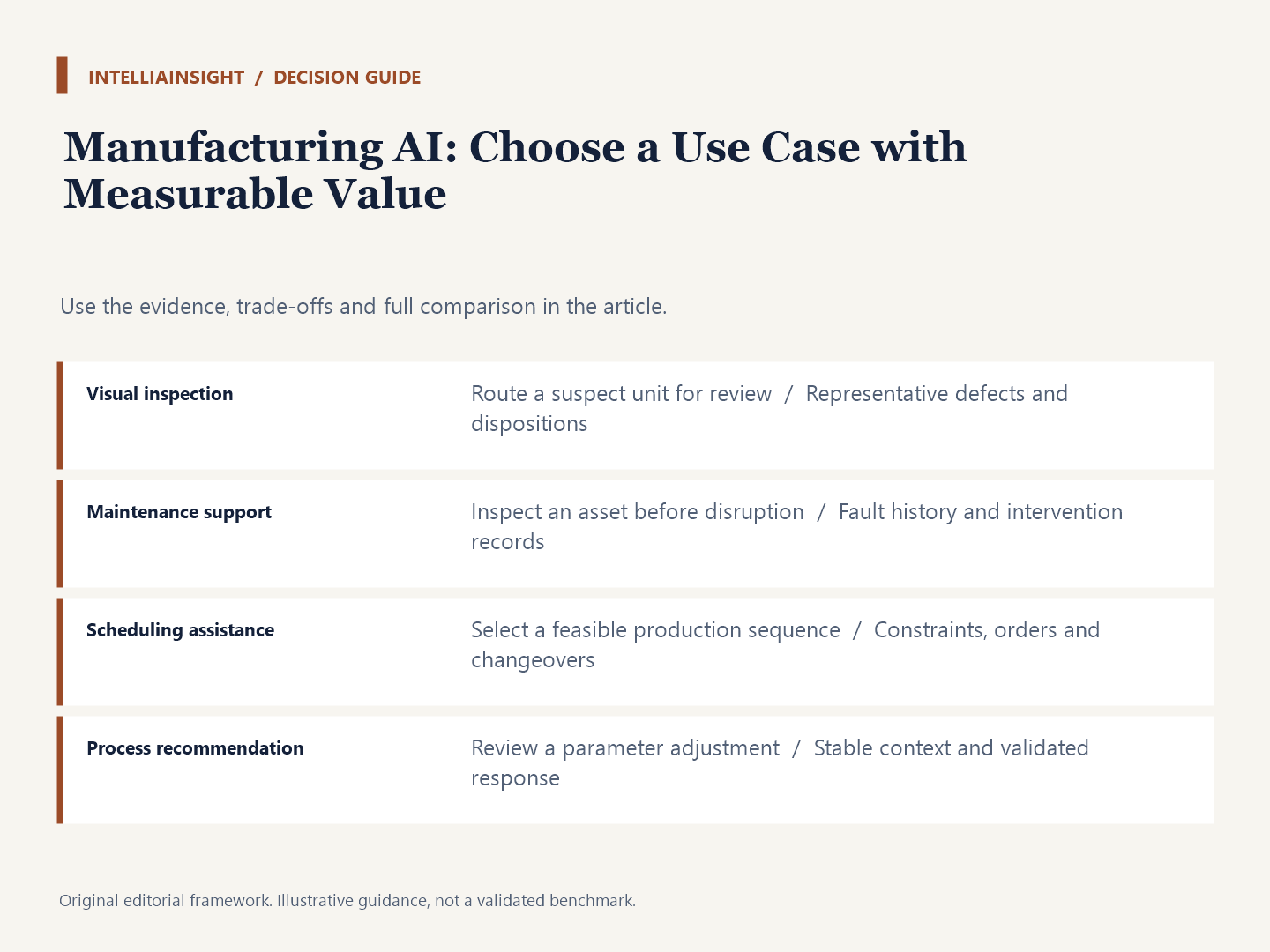
The following editorial framework evaluates readiness before comparing model features. It contains no industry scoring threshold. A missing action owner or unreliable label should trigger investigation rather than receive a cosmetic average score.
| Candidate | Decision to change | Evidence needed | Reason to defer |
|---|---|---|---|
| Visual inspection | Route a suspect unit for review | Representative defects and dispositions | Rare critical defects absent from tests |
| Maintenance support | Inspect an asset before disruption | Fault history and intervention records | No practical maintenance response |
| Scheduling assistance | Select a feasible production sequence | Constraints, orders and changeovers | Plans ignore material availability |
| Process recommendation | Review a parameter adjustment | Stable context and validated response | Unapproved control authority |
| Knowledge assistance | Find approved work instructions | Current controlled documents | Answers cannot identify their sources |
Use the table in an operations meeting with quality, maintenance, IT and OT representatives. Ask each person what could invalidate the proposal. A production manager may accept a useful alert that quality rejects as insufficient evidence for automatic release. That disagreement defines the boundary the pilot must preserve.
Establish a baseline that survives scrutiny
Document the current decision rule, production mix, shift patterns and relevant process changes. Record losses using consistent definitions. A rejected part, reworked part and customer return represent different events and should not be merged merely because the AI dashboard calls them all defects.
Retain the denominator and operating opportunity. A reduction in stoppage minutes during a period of lower demand does not necessarily represent better reliability. If the product mix or inspection policy changes, explain the effect before comparing periods. Finance and operations should sign the baseline definition before a vendor calculates benefits.
The baseline also includes labour needed to interpret data and handle exceptions. A pilot that appears to save inspection time may create extra engineering review or repeated image labeling. Those activities can be worthwhile, but they belong in the operating model and cost estimate.
Learn from selected industrial examples
The World Economic Forum's 22 June 2026 Lighthouse announcement describes Rockwell Automation's Singapore site using flexible automation, AI-enabled quality control and intelligent maintenance. This is a selected industrial transformation example, not a controlled comparison isolating AI.
Its useful lesson is to examine the surrounding operating system. Ask how product variety, operator knowledge, changeovers and quality decisions were handled. Do not import a headline result into your forecast or assume the named technologies caused the entire reported improvement. Selected Lighthouse sites are not a representative sample of all factories.
Request equivalent evidence from a prospective supplier: process context, starting conditions, implementation scope, acceptance criteria and continuing support. A reference visit should help reveal prerequisites and limitations. It should not become a substitute for testing your products, assets and failure consequences.
Work through an illustrative constraint calculation
Consider a hypothetical packaging plant investigating inspection support. These illustrative annual planning assumptions are not benchmarks: 1,000 suspect batches require review, each review uses 12 minutes, and a proposed tool might remove 4 minutes from a validated subset of 600 batches. The possible released review time is 600 multiplied by 4, or 2,400 minutes: 40 hours.
That calculation is a capacity estimate, not a cash saving. Finance should ask whether the time can reduce paid overtime, avoid external inspection or improve a constrained process. If it simply creates small gaps across many shifts, the benefit may remain operational flexibility rather than spend reduction.
Now include the exception burden. If the tool creates 200 additional reviews at 6 minutes each, it consumes 20 hours. Net review capacity released falls to 20 hours before labeling, support and training. A pilot should measure those extra reviews instead of reporting only the fast cases that the model handles successfully.
The plant might still proceed if the tool helps detect an important defect, but that requires separate quality evidence. A time calculation cannot prove adequate detection. Define the consequence of missed defects, include difficult cases and preserve the approved release process until the authorized team validates a change.
Keep production authority explicit
NIST's September 2023 Guide to OT Security addresses operational technology alongside its performance, reliability and safety requirements. Treat those requirements as design constraints when connecting an AI pilot to production systems.
Map data flows, identities, permissions and commands. A system described as advisory can still acquire write access through an integration or privileged account. OT engineering should verify actual configuration, isolate the approved scope and define how the plant returns to established operations when the service fails.
Run the pilot in an approved mode appropriate to its consequence. Shadow evaluation can reveal differences without changing production decisions, but it cannot demonstrate every effect of live use. Later phases need explicit authority, operator training and quality review. Do not move from a useful dashboard to autonomous process changes by informal agreement.
Decide whether to stop, revise or expand
Agree the decision record before the pilot: baseline, intended users, evaluation cases, benefit method, unacceptable outcomes and ownership after handover. Select duration and sample size for the relevant production cycles and failure scenarios; there is no universal pilot length that establishes readiness.
At review, separate three questions. Did the system perform the defined task? Did staff use its output in an approved decision? Did that decision improve the agreed process outcome after costs and adverse effects? A positive answer to the first question alone supports further investigation, not a factory-wide rollout.
Use our manufacturing coverage for related procurement decisions. Suppliers can connect a transparent use-case brief with the SaaS campaign planning guide when explaining decision evidence to different buyer roles.
Industrial technology vendors with a substantiated application story can explore Lidespy's content syndication services to reach relevant buying groups. IntelliAInsight is a Lidespy LLP publication.
Sources and research dates
- New Global Lighthouse Sites Demonstrate How AI Is Rewiring Manufacturing and Supply Chains | World Economic Forum — 22 June 2026.
- SP 800-82 Rev. 3, Guide to Operational Technology (OT) Security | CSRC — September 2023.
Common questions
Which manufacturing AI pilot should a plant start with?
Start where a meaningful process loss, usable evidence and a practical intervention meet. Compare the proposed AI with simpler remedies and name an owner who can act. Prefer a bounded decision with observable consequences over a broad platform demonstration whose success depends on several unowned process changes.
Can Lighthouse results justify our projected return?
They can suggest applications and questions, but should not supply your expected improvement. Lighthouse cases are selected transformations with different equipment, operating practices and starting points. Use your own baseline, complete implementation costs and sensitivity assumptions, and keep the case evidence separate from your financial estimate.
When should a promising pilot stop?
Stop or revise when its output cannot change an approved decision, data do not represent important operating conditions, exception handling overwhelms users or unresolved production risks exceed the authorized scope. A model can perform well technically while the proposed workflow remains impractical. Record that distinction in the review.
Link to this article
Writing about this? Copy the address, or the ready made link.
Get new stories by email
Join the list and be first to get our best stories when the newsletter starts. One click to unsubscribe.
Comments
No comments yet. Add the first one.