How to run payroll for the first time
A plain walkthrough for a US small business owner running payroll for the first time, in the order the steps actually happen, with links to the official sources.
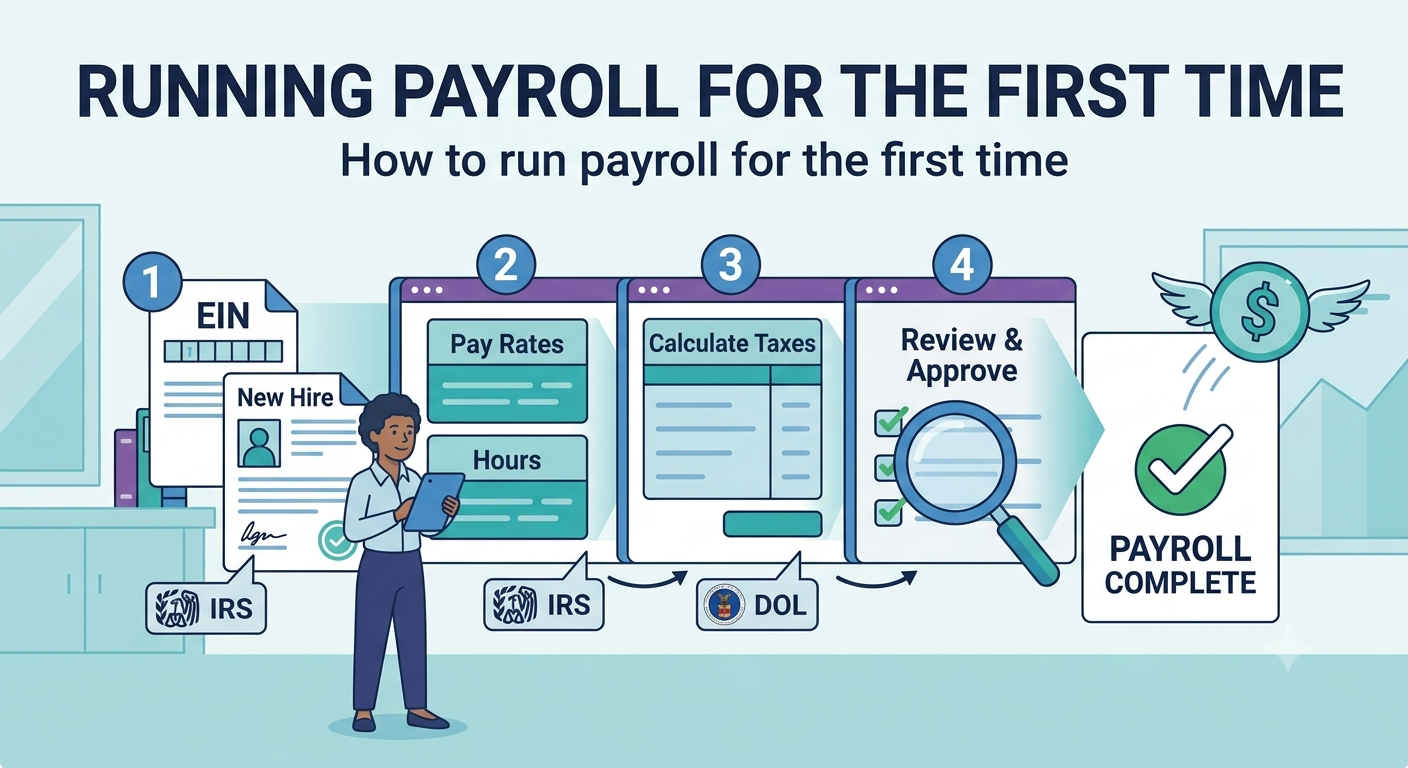
The hard part of your first payroll is not the maths. It is that several separate registrations, forms and deadlines have to be in place before anyone gets paid, and they come from different agencies that do not talk to each other.
Here is the order they actually happen in. Everything below is United States specific, and every number, rate and deadline should be checked against the official source rather than any article, including this one.
Before anyone gets paid: the registrations
Get an Employer Identification Number. This is your federal tax ID as an employer. You apply through the IRS, and the application is free. Be careful with search results here, because paid services rank above the official page. Go to irs.gov directly. [VERIFY: source, IRS page for applying for an EIN]
Register with your state. Most states require two separate registrations: one for state income tax withholding, and one for state unemployment insurance. These are usually different agencies with different logins. A few states have no personal income tax, which removes the first one but not the second. Find your state's department of revenue and its labor or workforce agency. [VERIFY: source, your state's withholding and unemployment registration requirements]
Check local taxes. Some cities and counties levy their own payroll or occupational taxes. This catches people out because nothing tells you about it until you are late. Ask your accountant, or check the city's finance department.
Open a separate bank account if you can. Payroll taxes you withhold are not your money. Keeping them separate from operating cash is the simplest way to avoid spending them by accident, which is a much more common failure than arithmetic errors.
What you need from each employee
Form I-9, to verify they are allowed to work in the United States. There are rules about when it must be completed and how long you keep it, published by US Citizenship and Immigration Services. [VERIFY: source, current I-9 completion and retention requirements]
Form W-4, which tells you how much federal income tax to withhold. Employees complete this, not you. The form has been redesigned in recent years, so use the current one from irs.gov rather than a copy you saved. [VERIFY: source, current year Form W-4]
A state withholding form, where your state has one. Some states use the federal W-4, others have their own.
Bank details for direct deposit, and a signed authorisation if your state requires one.
New hire reporting. Every state requires you to report a new employee to a state directory within a set number of days. This one is easy to miss because it is not part of any tax form. [VERIFY: source, your state's new hire reporting deadline]
Decide the pay schedule before the first run
Weekly, every two weeks, twice a month, or monthly. Two things to know.
Some states set a minimum frequency, and some set rules about how soon after a pay period ends you must pay. You cannot simply choose whatever suits your cash flow. [VERIFY: source, your state's pay frequency and timing rules]
Every two weeks and twice a month are not the same thing. Every two weeks gives 26 pay runs a year and occasionally three in a month. Twice a month gives 24 and is easier to reconcile against monthly accounting, but the pay dates fall on different weekdays.
Pick one and keep it. Changing pay frequency later is its own project, and in some states it requires advance notice to employees.
What happens in a single pay run
Work out gross pay. Salary divided by the number of pay periods, or hours multiplied by rate. If anyone is non exempt and worked more than the overtime threshold, overtime is owed at the required rate. Whether someone is exempt is a legal test under the Fair Labor Standards Act, not a matter of whether they are salaried, and the Department of Labor publishes the current tests and thresholds. [VERIFY: source, Department of Labor guidance on FLSA exemption tests and overtime]
Withhold from the employee. Federal income tax based on their W-4. Social Security and Medicare, the employee half. State and local income tax where they apply. Anything they have agreed to, such as a retirement contribution or their share of health insurance.
Add what you owe as the employer. Your matching half of Social Security and Medicare, federal unemployment tax, and state unemployment tax at whatever rate your state has assigned you. Your unemployment rate is specific to your business and changes over time, so use the rate on your state notice rather than a general figure. [VERIFY: source, IRS Publication 15 for federal withholding and employer taxes]
Pay the employee and give them a pay stub showing gross, each deduction and net. Most states require the stub, and some specify what has to be on it. [VERIFY: source, your state's pay statement requirements]
After the run: deposits and filings
This is the part that carries penalties, and the part people forget because the employees have already been paid and nothing looks wrong.
Deposit the withheld taxes. You are holding money that belongs to the government. How often you deposit depends on your deposit schedule, which the IRS assigns based on your history. Getting this wrong is expensive, and the schedule can change from one year to the next. [VERIFY: source, IRS deposit schedule rules in Publication 15]
File the returns. There is a regular federal employment tax return, an annual federal unemployment return, and state returns on their own schedules. Your state's calendar will not match the federal one.
Year end. W-2 forms go to employees and to the Social Security Administration by a deadline in the new year, with penalties for filing late. [VERIFY: source, current W-2 filing deadline and penalties]
Software or by hand?
If you have one employee and a steady salary, doing it by hand is possible. The arithmetic is not the risk.
The risk is the calendar. Deposit schedules, quarterly returns, state filings and year end forms all have dates attached, and missing them costs money in a way that a small rounding error does not.
If you do it by hand, the first thing to do after registering is to put every deadline for the next twelve months into a calendar with reminders a week ahead.
If you use software, you are mostly buying that calendar being handled for you. When comparing providers, the questions that matter are which of your states it supports, whether it files and deposits on your behalf or only calculates, what happens when a filing is wrong, and how you get a human on the phone.
Before your first payday, check these
- EIN issued, and state withholding and unemployment accounts open
- I-9 completed and stored, W-4 and any state form on file
- New hire report submitted within your state's deadline
- Pay schedule chosen and legal in your state
- Exempt or non exempt decided for each person, against the DOL tests
- Deposit schedule known and diarised
- Payroll tax money held separately from operating cash
One last thing
Talk to an accountant before the first run, not after the first mistake. An hour of their time costs less than one late deposit penalty, and they will know the local taxes that no national guide mentions.
This article is general information, not tax or legal advice. Rules differ by state and change every year. Use irs.gov, dol.gov and your own state agencies as the source of truth.
Common questions
Do I need payroll software, or can I do it by hand?
You can do it by hand, and for one or two employees some owners do. The risk is not the arithmetic, it is the deposit deadlines and the filings. Software handles those on a schedule. If you do it by hand, put every deadline in a calendar the day you register.
What is the first thing to do?
Get an Employer Identification Number from the IRS, then register with your state for withholding and unemployment insurance. Nothing else can happen until those exist.
What happens if I get it wrong?
Late deposits and late filings carry penalties and interest, and the rules for correcting them differ depending on what went wrong. The IRS publishes the current penalty structure and the correction process, so check there rather than guessing. [VERIFY, source, IRS guidance on employment tax penalties and corrections]
Link to this article
Writing about this? Copy the address, or the ready made link.
Get new stories by email
Join the list and be first to get our best stories when the newsletter starts. One click to unsubscribe.
Comments
No comments yet. Add the first one.